


Historic images are among the highlights of the ‘Magnum 65 Years’ photo exhibition that opened at Katara Gallery 1 in Building 13 yesterday evening.
The exhibition that runs until February 12 with daily timings of 10am to 10pm, is the first of a series of collaborative projects between the leading global photo agency and the Cultural Village Foundation (Katara).
The exhibition outlines the history of Magnum Photos, founded in 1947 by Henri Cartier-Bresson, Robert Capa, George Rodger and David Seymour, four acclaimed photographers.
It offers a linear and evolving account of Magnum’s six decades transcending the rift between photojournalism and artistic practice.
Texts and quotes from the photographers add to the dimension of the experience behind images that have shaped the visual iconography and collective memory of the past 65 years.
The exhibition includes a selection of interactive large-scale projections of over 5,000 images from 81 photographers.
David Hurn, a Magnum photographer of 60 years, who has come to Qatar along with his colleague Nikos Economopoulos, said that most of the images in the exhibition are part of a story.
Fiona Rogers, cultural and education manager, Magnum Photos London, explained that each year between 1947 and 2012 is represented by significant images.
Many evergreen and legendary photographs are part of the exhibition. These include ‘The Decisive Moment’ (by Henri Cartier-Bresson), the late Hollywood heartthrob James Dean strolling through a rain-soaked New York City (by Dennis Stock), Ernesto ‘Che’ Guevara (by Rene Burri), Malcolm X (by Eve Arnold) , boxing legend Mohamed Ali (by Thomas Hoepker), Afghan woman Sharbat Gula (by Steve McCurry) and many more.
Magnum, initially based in Paris and New York and more recently adding offices in London and Tokyo, departed from conventional practice in two fairly radical ways. It was founded as a co-operative in which the staff, including co-founders Maria Eisner and Rita Vandivert, would support rather than direct the photographers.
Copyright would be held by the authors of the imagery, not by the magazines that published the work. This meant that a photographer could decide to cover a famine somewhere, publish the pictures in Life magazine, and the agency could then sell the photographs to magazines in other countries, such as Paris Match and Picture Post, giving the photographers the means to work on projects that particularly inspired them even without an assignment.
Dr Khalid al-Sulaiti, general manager of Katara described the exhibition as another testimony of Katara’s ongoing commitment to portray the best of art and bridge the gap between different cultures.
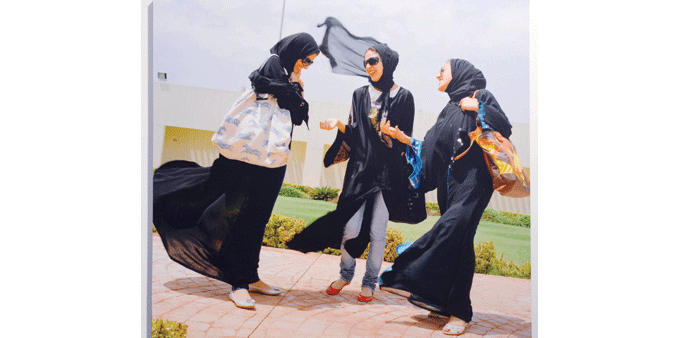
A 2009 image from ‘Jeddah Diary’ by Olivia Arthur