


|
|
Venezuela’s Supreme Court yesterday said ailing President Hugo Chavez could indefinitely postpone his swearing-in to a new term and that his current administration could continue to govern in the meantime.
A panel of seven magistrates unanimously upheld the constitutionality of the delay amid a national debate over whether the cancer-stricken Chavez had to at least temporarily hand over power if he was unable to take the oath of office today, when his new term is to begin.
“The oath-taking of the re-elected president can be carried out at a time after January 10 before the Supreme Court, if it is not done on the said day before the National Assembly,” the ruling said.
In the meantime, the officials of the current administration “will continue fully exercising their functions under the principle of administrative continuity,” it said.
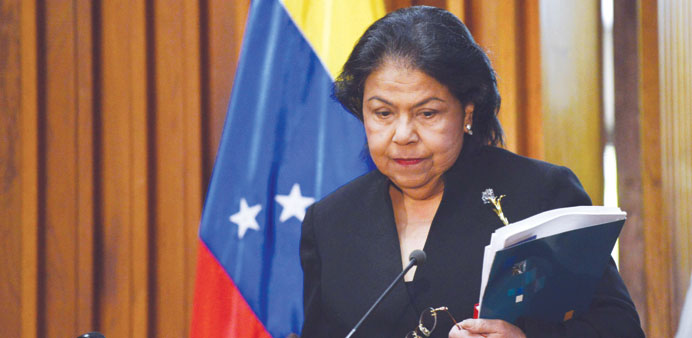
Supreme Court president Luisa Estella Morales, who read out the decision, also ruled out convening a medical board to assess the health of the president, who was in Cuba recovering from a fourth round of cancer surgery.
“At no time has the Supreme Court considered that there were merits to convening a medical board at this time,” she said.
Chavez, 58, has now been absent from the country for a month, out of view for the longest stretch of his 14 years in office, raising great uncertainties about his condition. The government has said that he is recovering from complications from surgery, most recently a severe pulmonary infection that had resulted in a “respiratory insufficiency.”
Information Minister Ernesto Villegas said late Monday that Chavez’s medical condition was unchanged. After days of suspense, the government confirmed Tuesday that Chavez was too sick to return to Caracas for his scheduled swearing-in today and would take the oath of office at a later date before the Supreme Court.
“According to the recommendation of the medical team... the process of post-operative recovery must extend beyond January 10 of the current year, reason for which he will not be able to appear on that date before the National Assembly,” said a letter to the assembly from Vice President Nicolas Maduro.
Maduro’s letter went on to say that, in keeping with Article 231 of the constitution, Chavez would take the oath before the Supreme Court at a later day. With a show of hands, the Chavez-controlled assembly approved the open-ended absence of the president, who has dominated the country personally and politically since coming to power in 1999.
“President Chavez, this honorable assembly grants you all the time that you need to attend to your illness and return to Venezuela when the unexpected cause (of your absence) has disappeared,” said assembly speaker Diosdado Cabello.
Leaders of the leftist government insist that, under the circumstances, the president’s current term can be extended beyond the January 10 inauguration date until he is well enough to be sworn in to another six-year term. Opposition leaders argue that the constitution required the president to be declared “temporarily” absent and the presidency be turned over to Cabello on an interim basis. But the president’s top aides, including Cabello, fiercely rejected that formula and insisted that there be no transition of power. Maduro, handpicked by Chavez as his political successor, has assumed the leadership of the government in his absence.