


For the first time details about wind and wave conditions around the coast of Qatar has been recorded in a study funded by Qatar National Research Fund (QNRF).
In order to collect the data, a research team at Texas A&M University at Qatar positioned the most sophisticated equipment available on the edge of a 500m pier extending into the Gulf.
Their findings highlight the need for a permanent monitoring station in Qatar with the potential to offer vital insights into many industry sectors.
“The actual research started in trying to understand the relationship between the wind and waves,” said Reza Sadr, assistant professor in the Mechanical Engineering Department at TAMU-Q.
“Why do we need to understand the relationship between wind and waves? Because there are very poor models to track wind current and predict ocean waves, and this information affects, among other things, marine life, the offshore oil and gas industry, and renewable energy initiatives.”
Sadr also explained that the existing methods for measuring the patterns of wind and waves need to be fortified with more sophisticated data and analysis for each region of the globe.
“The US navy is studying this, as are oil companies, but the data available is not of high quality,” he said.
“One thing that we know so far, however, is that the patterns around the world are different. The North Sea is different to the Atlantic Ocean, which is different to the Gulf of Mexico. Even within the Atlantic Ocean there are differences, from, say, Cuba and then up toward New York City and Boston. Knowing this, we understand how critical it is to characterise the conditions for each place specifically.”
The study was supported by a grant under QNRF’s National Priorities Research Programme (NPRP), and was the first of its kind to be conducted anywhere in the region.
The researchers collected data continuously for six months, from June through to November, in Qatar.
They used devices that rely on sonic waves to measure atmospheric wind at high frequency and in several dimensions, allowing them to study fluctuations in wind movement in the midst of high temperatures and humidity.
The collation of comprehensive data on wind and its impact on waves would contribute greatly to the oil and gas industry as it increasingly moves offshore, Sadr said.
The information would additionally serve the aviation industry as Qatar positions itself as a regional hub with its massive new international airport scheduled to open in the near future.
As the nation looks seriously into renewable wind energy, the applications become particularly important in studying turbulence, which must be specifically modelled for each location and system.
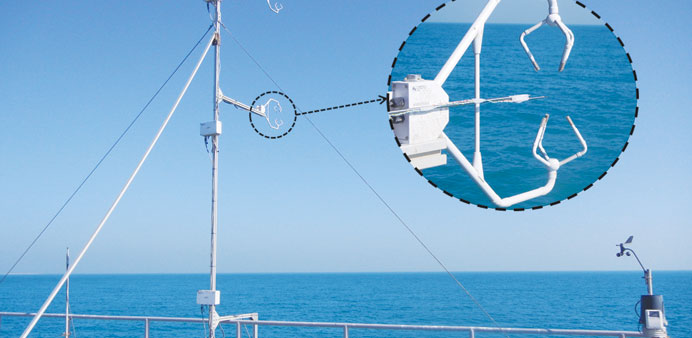
Sonic anemometers use sonic waves to measure atmospheric wind.