


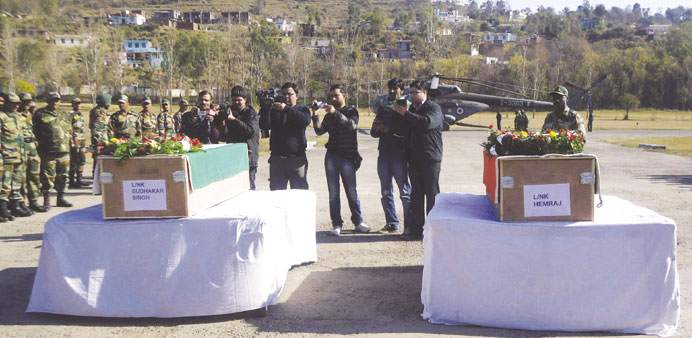
Members of the media film the coffins containing the bodies of two soldiers at a garrison in Rajouri district, about 170km northwest of Jammu yesterday.
Agencies/Jammu
India yesterday denounced Pakistan over a firefight in Jammu and Kashmir in which two Indian soldiers were killed, but the neighbours both appeared determined to prevent the clash escalating into a full diplomatic crisis.
India summoned Pakistan’s envoy in New Delhi to lodge a “strong protest,” accusing a group of Pakistani soldiers it said had crossed the heavily militarised Line of Control (LoC) in Kashmir of “barbaric and inhuman” behaviour.
The body of one of the soldiers was found mutilated in a forested area on the side controlled by India, Rajesh K Kalia, spokesman for the Indian army’s Northern Command, said. However, he denied media reports that one body had been decapitated and another had its throat slit.
“Regular Pakistan troops crossed the Line of Control ... and engaged the Indian troops who were patrolling the sector,” the Ministry of External Affairs said in a statement after Pakistan’s high commissioner to India Salman Bashir had been called in.
“Two Indian soldiers were killed in the attack and their bodies subjected to barbaric and inhuman mutilation.”
External Affairs Minister Salman Khurshid sought to cool tensions, however, saying that exhaustive efforts to improve relations could be squandered if the situation was not contained.
“I think it is important in the long term that what has happened should not be escalated,” Khurshid told a news conference. “We cannot and must not allow the escalation of any unwholesome event like this.”
“We have to be careful that forces ... attempting to derail all the good work that’s been done towards normalisation (of relations) should not be successful,” he added, without elaborating on who such forces might be.
India and Pakistan have fought three wars since 1947, two of them over Kashmir, and both are now nuclear-armed powers.
Away from the border, ties had appeared to be improving of late. Pakistan’s cricket team completed a two-week tour of India on Sunday, its first visit in five years.
Firing and small skirmishes are common along the 740km LoC despite a ceasefire that was agreed in 2003.
However, incursions by troops from either side are rare. Retired Indian army Brigadier Gurmeet Kanwal, who previously commanded a brigade on the LoC, said Tuesday’s incident - about 600m from the de facto border - marked the most serious infiltration since the ceasefire was put in place.
Indian army officials said cross-border firing broke out hours after the clash but, yesterday, the LoC was quiet.
Naveed Chand, a shopkeeper in Chatar village just 2km from the LoC on the Pakistani side said by telephone that there had been a pick-up in cross-border firing recently, unusual movements of army trucks and reinforcement of bunkers.
“We think something is up. People in the area are very alarmed,” he said.
It was not possible to independently verify events in the remote area, which is closed to journalists on both sides.
In a sign of a desire for revenge among troops on the ground, an Indian officer said it was “now a matter of prestige, the battalion has to regain its honour.”
Defence Minister A K Antony said the Pakistan army was guilty of “inhuman” behaviour in the treatment of the bodies while newspaper headlines stoked the tensions, with the Mail Today denouncing “Pak Army Butchers.”
But amid the chorus of condemnation, Pakistan’s Foreign Minister Hina Rabbani Khar appeared on Indian television to issue a firm denial and criticise the statements by authorities in Delhi.
“Let me just say that we are a bit appalled at some statements that are coming in from India because the government of Pakistan has absolutely rejected that any such incident took place,” she told CNN-IBN network.
“It is not Pakistan’s policy to not observe ceasefire on LoC,” she added.
Khar said Pakistan tempered its language after the death of one of its soldiers on Sunday in a border skirmish and India should have followed suit.
“We believe that these issues must be dealt with in a responsible manner,” she said.
“We can ask a third party to do investigation on this, you know that UN military observers exist, we can call them.
“It is not Pakistan’s policy to do tit-for-tat... We must not all go back to having a go at each other.”
A Pakistani army spokesman described India’s charges as “propaganda” aimed at diverting attention away from the Indian incursion two days earlier. India denies that its troops crossed over the line during last weekend’s incident.
Mushahid Hussain, a Pakistani senator and member of the Parliamentary Committee on National Security, said the Indian government - dogged by corruption scandals and facing a tough election as early as this year - was returning to “the war-like language of the past” for domestic political reasons.
“Pakistan has its hands full with a full-blown insurgency inside its borders. It doesn’t suit Pakistani interests at all to raise the temperature along the LoC,” Hussain said.
There was little coverage of the skirmish in Pakistani media, but a succession of commentators voiced fury on Indian news channels and the main opposition party urged the government to expose Pakistan’s actions to the international community.
“Pakistan can be named and shamed for this brutal attack,” Bharatiya Janata Party leader Arun Jaitley told reporters.
Some commentators drew parallels between Tuesday’s clash and a conflict in 1999 when Pakistan-backed infiltrators occupied the heights in Kargil, in the north of Kashmir. India lost hundreds of troops before re-occupying the mountains after fighting that almost triggered a fourth war.
“India’s response will be measured but, as a former soldier, I do not rule out a measured military response to teach them a lesson,” said retired Brigadier Kanwal. “You cannot tinker with bodies.”
BELOW: Activists from the main opposition Bharatiya Janata Party shout anti-Pakistan slogans during a protest march to the Pakistani embassy in New Delhi yesterday.