


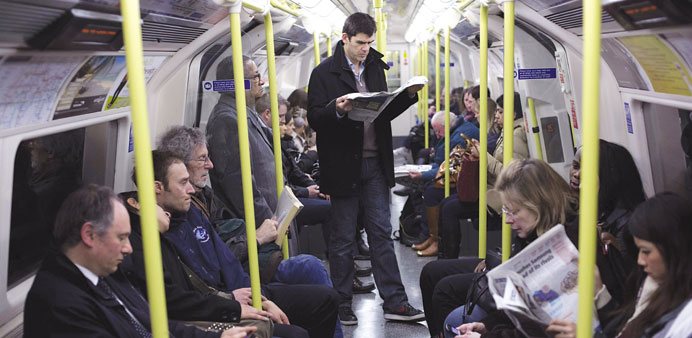
A commuter reads a newspaper on a train in the Tube yesterday. The London Underground transportation system, better known as the Tube is celebrating its 150th year anniversary in 2013.
Agencies/London
The London Tube boss yesterday warned that passengers could suffer years of disruption because of a £12bn funding gap in planned upgrades to two lines.
Transport for London’s managing director Mike Brown called for government cash to complete the Piccadilly and Bakerloo lines’ modernisation as well as upgrades to Bank, Monument and Holborn stations.
He said reliability on the services — with 30-year-old trains operating on the Piccadilly line — would be affected and cash would be wasted on repairs.
Speaking at yesterday’s 150th anniversary of the Tube, the world’s oldest underground railway, he accused ministers of undermining growth with intermittent funding of London transport projects.
“There is a ridiculous stop-start approach where you order trains one day and then say there’s no further commitment. It’s mad,” he said.
“All the benefits you have seen in reliability will plateau and we will be spending a huge amount of money to sustain performance rather than to improve. If the Piccadilly line fleet is not replaced in 10 years there will be more failures of signals and trains.”
Funding has already been secured for the Northern line upgrade, to be completed in 2014, new trains and signalling for the “sub-surface” routes comprising 40% of the network and for the Hammersmith & City, Metropolitan and Circle lines.
The modernisation programme has included recent upgrades of the Jubilee and Victoria lines.
If funding is granted, the Piccadilly line could acquire the first articulated trains with walk-through carriages, and air conditioning to improve hot and cramped conditions.
The Waterloo & City, Piccadilly and Central lines could be the first to see driverless trains introduced, but not until the middle of the next decade, said Brown.
Computer technology led to improved acceleration and braking times and also a more frequent service, he added.
Trains on the Jubilee, Victoria and Central lines are already driven automatically, though the cabins are manned.
Brown said: “I imagine in the middle of the next decade you’ll see driverless trains running if we get a settlement soon. Around the world 75% of new metro trains are with driverless trains but to convert old lines like ours is much more complex.”
The first underground journey saw steam trains running from Paddington to Farringdon in 1863. Brown said: “London is arguably the greatest city in the world and it’s very unlikely that would have happened without the fast links connecting villages and communities to the metropolitan mass.”
Meanwhile, London mayor Boris Johnson has called the network affectionately known as the Tube “arguably the best, and most iconic, underground system in the world”.
A series of events were held to mark the milestone, including trips by steam trains through Tube tunnels and two new two-pound coins commemorating the anniversary.
Twelve short stories were released by well-known authors each focusing on one Tube line, and more broadly on what the Underground means to Londoners and visitors.
The original Underground, opened after just three years’ construction, was designed to reduce congestion above ground from carts and stagecoaches.
Today the Underground employs 19,000 people and carries passengers between 270 stations each year, linking London with its commuter belt including Surrey, Kent, Essex and Hertfordshire.
Waterloo is its busiest station, with 82mn passengers passing through each year.
It has borne witness to key moments in Britain’s history, sheltering 175,000 people from bombings during World War II and bearing the impact of terrorist attacks in 2005 which killed 56 people on three Tube lines and a bus.
A huge fire left 31 people dead in 1987 at King’s Cross Station, leading to a safety overhaul and smoking ban. But it continues to develop, with the latest innovations including air-conditioned trains and high-frequency services planned on the Victoria and Central lines.