


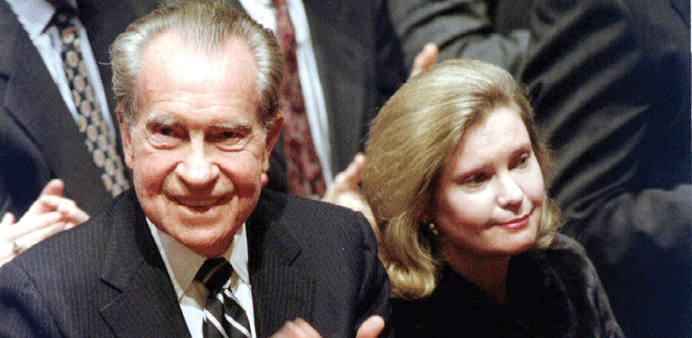
Former US president Richard Nixon and his daughter Patricia Nixon Cox applaud during a memorial service in New York in this December 29, 1993, file photo. Nixon, a divisive figure in US politics who became the only sitting president ever to leave office when he resigned over the Watergate scandal, would be turning 100 years old this week if he were alive.
By Michael /Mello
For five years, he was known as the leader of the Free World.
But for the first several years of his life, Richard Milhous Nixon had a more modest title: farm boy.
Today marks the date, 100 years ago, of a winter day so cold that Hannah Nixon was advised it would be better to bear her fifth son at home than risk travelling in the chill to a hospital. That was the day a small, kit-constructed home surrounded by citrus trees saw the birth of the man who would become the 37th president of the United States.
The small home is now one of the most popular exhibits at the Nixon Presidential Library & Museum in Yorba Linda, California but it was only Nixon’s home for a few scant years before failed crops forced his family to Whittier.
Still, even as he rose through the highest ranks of American government, Nixon remembered his roots. Referring to his parents in his 1968 Republican National Convention acceptance speech, Nixon described his father as a man “who had to go to work before he finished the sixth grade, sacrificed everything he had so that his sons could go to college.”
“People who knew my father, they knew throughout his life he was a very forward-looking person,” said Richard Nixon’s younger daughter, Patricia Nixon Cox. “But his childhood in Orange County meant very much to him. He grew up in a very close-knit and loving family.”
A staunch anti-communist and a fierce debater with a love of foreign lands, some of Nixon’s first travels were from his home in Whittier to the farmers markets in downtown Los Angeles.
He made the daily drives at 4am each day, enough time to wash the newly purchased produce and set it up at his parents’ combination petrol station and grocery store before heading off for the day’s classes at high school.
He could pick up any fruit, Nixon Cox said: “He could tell you within hours of when it would be perfect. He spent his high school years doing that.”
Looking back now, it’s easy to see how some of the pieces of Nixon’s character showed themselves in those early years.
Visitors to the Nixon Birthplace today find old issues of National Geographic in the living room, Nixon’s favourite reading material.
“He was always interested in seeing the world and seeing how other countries fit into the whole world,” Nixon Cox said.
In 1927, he was one of the stars on the Fullerton Union High School debate team.
“We were all encouraged to do what we enjoy,” said Ed Nixon, the former president’s youngest brother. “Dick was always interested in debate, and my father encouraged that.”
Lifelong Whittier resident Hubert Perry attended high school and Whittier College with Nixon.
“He was six months older than me and a lot smarter. I never caught up with him,” Perry, 99, joked. Even then, “You knew he was going to do something worthwhile, because he was smarter than anyone else.”
Perry’s home resembles a shrine to his friend. One bookshelf is stuffed with volumes written by — and about — Nixon and his White House aides. Then there are the photos of Nixon and the letters from him.
It was Perry’s father, H L Perry, who wrote to Nixon to ask him to run for Congress upon his return from naval service after World War II. Nixon took his local seat from a Democrat who had held it for several terms. A mere six years later, Nixon had risen through the ranks of the US Senate to be vice president.
“He jumped up much faster than other people in the political scheme,” said Perry, who remained friends with Nixon throughout the years. “That’s because he was articulate and was a scholar of politics.”
Friends and foes alike agree that one of Nixon’s defining traits was his stubbornness. Maybe that’s what kept him from giving up after losing the presidential election to John F Kennedy in 1960. Two years later, he lost the California governor’s race to Edmund G “Pat” Brown, the father of current Governor Jerry Brown.
Following the latter, Nixon gave a famous speech where he announced, “You won’t have Nixon to kick around anymore.”
But in 1968, Nixon beat Vice President Hubert Humphrey to win the Oval Office, carrying California in the victory. Nixon had great triumphs in his early years, signing legislation to adopt Title IX, helping women’s equality; expand the food stamps programme; and preserve clean water.
Most see Nixon’s efforts to help normalise relations with China, the world’s largest country, as the pinnacle of his political career.
Even now, Ed Nixon, a geologist, gets recognised there because of his name and his resemblance to his brother.
“It’s embarrassing. I’m not going to meet anybody in government or a mayor. I just want to meet with a geologist poking around in a tin mine in Hunan ... but they put out the red carpet,” Ed Nixon said. “I’ve been to 40 countries around the world, and Nixon’s name works wonders.”
Nixon Cox said “the twin pillars of my father’s legacy are peace and the victory of free-market capitalism. I think my father’s guiding principles were peace and justice ... because without justice, peace is only ephemeral. Everything he did in the international area was to bring about a lasting peace.”
Still, the stain of the cover-up of the 1972 break-in at the Democratic National Committee headquarters remains.
“It’s a legacy that will live with honour,” Ed Nixon said. “Richard Nixon did not resign in shame. He died knowing he accomplished what he tried to do. He was cut short, but he did a lot of things that people didn’t think he could do. China was just one of them.”
There seems to be no easy answer to how future generations will view the 37th president.
“He leaves a very complex legacy,” said Tim Naftali, a presidential scholar. “Richard Nixon’s legacy will always be a mixture of light and shadow.”
Naftali was the first director of the Nixon Presidential Library & Museum in 2007 when the federal government took it over from the non-profit Nixon Foundation. The foundation — a group of Nixon family members and loyalists — built the library and ran it privately for years. Naftali left his post late last year to work full time on writing books.
“There were impulses in his (Nixon’s) approach to public service that ultimately brought him down. The positive achievements, which no one can take away from him, must be put in the context of some very troubling approaches to leadership,” Naftali said. “There are some very troubling aspects to his legacy, and students of the American presidency cannot walk away from them.”
Though Nixon left office in disgrace, every president to succeed him during his lifetime called him for advice, particularly Democrat Bill Clinton.
“Every time I made a visit to his office, there was some conversation going on with the White House,” Ed Nixon said. “The fact he was communicating with his successor means that they respected his experience.” — The Orange County Register/MCT
President gets
the star treatment
By Jean Merl
Paul J Carter was 9 when Richard M Nixon resigned the presidency in 1974, watching the televised speech with his dad, a loyal Republican who had come home from work early for the event.
“I ... didn’t grasp the magnitude of it,” said Carter, now 47 and a lawyer in Long Beach.
Nearly four decades later, the boy’s puzzlement over the Unites States’ 37th president had evolved into a grown-up project, Native Son Richard Nixon’s Southern California: My Life on a Map!
Made like a guide to Hollywood stars’ homes, the fold-out map is an illustrated romp through the life of the only White House occupant born and raised in Southern California. It’s a hot item at the Nixon Presidential Library & Museum in Yorba Linda, with more than 500 copies snapped up last year at $4.99 each.
“It’s a really, really good seller,” said Jonathan Movroydis, spokesman for the Richard Nixon Foundation.
He expects sales to jump with Sunday’s launch of a yearlong celebration of the centennial of Nixon’s January 9, 1913, birth. The small farmhouse where Nixon entered the world is pictured on the map, with the long-gone citrus trees his father had planted on 9 acres surrounding the home.
The copyrighted map — whose cover depicts its bemused subject reading it — is dotted with photos and with drawings by artist Jean-Louis Rheault and includes milestones in Nixon’s controversial career. But check out Nixon as a frowning schoolboy at Yorba Linda Elementary, where, the map notes, he “often went to school barefooted” (which may explain the scowl).
There’s the Los Angeles Memorial Coliseum, where Nixon sports his 1933 Whittier College football uniform against USC: “Whittier lost 51-0.” Elsewhere, infant Tricia pops from the roof of the hospital where the first of Pat and Richard Nixon’s two daughters was born in 1946.
And there’s a Bundy Drive home where, the caption says, Nixon stood on the roof with his hose in 1961 as a fire raged through the neighbourhood. The map says he hit a hole-in-one at the Bel-Air Country Club the same year.
Does anybody recall a slogan for Nixon’s losing 1962 gubernatorial campaign against Pat Brown? Here’s one on a billboard: “Click with Dick...”
World leaders commemorated at the Nixon library make an appearance — Mao Zedong, Charles De Gaulle, Golda Meir. A miniature Nikita Khrushchev points angrily, as if repeating his 1956 “We will bury you!” threat.
For those who remember the famous photograph of Nixon walking on the beach in wing-tip shoes, there is this counterpoint: an illustration of a hairy-chested Nixon in red trunks in the ocean off San Clemente. The president was swimming there, the caption says, when the “First Article of Impeachment was voted up by Congress” in 1974.
Carter said he wanted the map to be fun, easily understood and hard to stop looking at — and a more complete picture of the man still known largely for the Watergate scandal.
A map of Carter’s Nixon-related life might start with the Palos Verdes Peninsula home of his childhood, then move on to California State Fullerton, where he was a student in the early 1990s. The political science major’s service-minded mother suggested her son volunteer at the Nixon library, where he met the former president several times.
“I had assumed he was mean,” Carter said in a recent interview in his office with a view of the Queen Mary. “But he was very nice, and that got me intrigued and wanting to know more about him.”
Carter admired Nixon’s devotion to his family and the loyal friends who stood by him for life. “If you were a bad guy,” Carter said, “people wouldn’t stick with you like that.”
After graduating from Drake University’s law school in 1995, Carter began planning his “native son” project. A chance meeting with the mayor of Whittier in 2009 finally got it off the ground.
“I said something like, ‘It must be fascinating to have all these places marked where (Nixon) grew up,’” Carter recalled. But the mayor said, “‘Well, we’ve kind of lost track of them.’ I couldn’t believe it.”
After more than 18 months of research and six more working with the artist, the map was published.
By then, Carter was a partner in a busy law firm, serving on the board of a local hospital and its foundation, supporting area Republicans and volunteering with his college alumni association. He and his wife, Sandra, a Democrat (she’s “very, very tolerant,” her husband says wryly), had adopted four children, now 4, 6, 7 and 11.
“But the finished project was worth it,” he said, and he’s recouped his $2,000 investment.
In fact, he’s already at work on another bio-map, of Ronald Reagan. Carter said Nixon’s younger daughter, Julie, and her husband, David Eisenhower, grandson of President Dwight Eisenhower, have asked for one on Ike.
Carter said he’d like to do all the presidents, but that one may have to wait. After the Reagan project, Carter plans one on a Democrat. He hasn’t decided between Bill Clinton and John F Kennedy. — Los Angeles Times/MCT
BELOW: The home that President Richard Nixon was born in and lived in, located on the grounds of the Richard Nixon Presidential Library and Museum in Yorba Linda, California.