


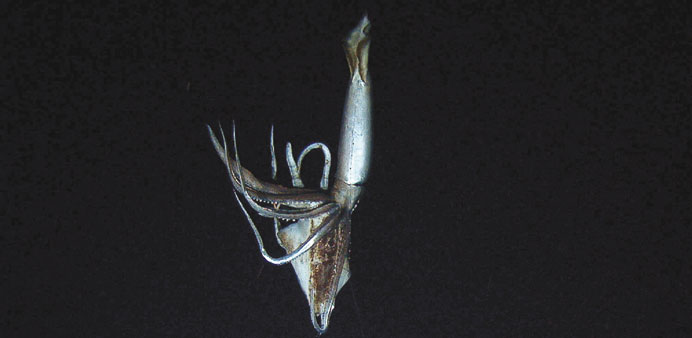
This video image, taken from footage by NHK and Discovery Channel and released yesterday shows a giant squid, up to eight metres long, against the backdrop of dark oceanic depths at a depth of 630 metres in the sea near Ogasawara islands, 1,000km south of Tokyo.
AFP/Tokyo
Scientists and broadcasters said Monday they have captured footage of an elusive giant squid roaming the depths of the Pacific Ocean, showing it in its natural habitat for the first time ever.
Japan’s National Science Museum succeeded in filming the deep-sea creature at a depth of more than half a kilometre (a third of a mile) after teaming up with Japanese public broadcaster NHK and the US Discovery Channel.
The massive invertebrate is the stuff of legend, with sightings of a huge ocean-dwelling beast reported by sailors for centuries.
The creature is thought to be the genesis of the Nordic legend of Kraken, a sea monster believed to have attacked ships in waters off Scandinavia over the last millennium.
Modern-day scientists on their own Moby Dick-style search used a submersible to descend to the dark and cold depths of the northern Pacific Ocean, where at around 630 metres they managed to film a three-metre specimen.
After around 100 missions, during which they spent 400 hours in the cramped submarine, the three-man crew tracked the creature from a spot some 15 kilometres (nine miles) east of Chichi island in the north Pacific. Museum researcher Tsunemi Kubodera said they followed the enormous mollusc to a depth of 900 metres as it swam into the ocean abyss.
NHK showed footage of the silver-coloured creature, which had huge black eyes, as it swam against the current, holding a bait squid in its arms.
For Kubodera it was the culmination of a lengthy quest for the beast.
“It was shining and so beautiful,” Kubodera said. “I was so thrilled when I saw it first hand, but I was confident we would because we rigorously researched the areas we might find it, based on past data.”
Kubodera said the creature had its two longest arms missing, and estimated it would have been eight metres long if it had been whole. He gave no explanation for its missing arms.
He said it was the first video footage of a live giant squid in its natural habitat—the depths of the sea where there is little oxygen and the weight of the water above exerts enormous pressure. Kubodera, a squid specialist, also filmed what he says was the first live video footage of a giant squid in 2006, but only from his boat after it was hooked and brought up to the surface.
“Researchers around the world have tried to film giant squid in their natural habitats, but all attempts were in vain before,” Kubodera said.