


By Joey Aguilar/Staff Reporter
Five Filipinos who were pardoned recently by HH the Emir Sheikh Hamad bin Khalifa al-Thani are now at the Deportation Centre awaiting their repatriation to the Philippines.
In a press statement, the Philippine embassy said the Emir pardoned three men and two women from the Philippines to mark the Qatar National Day on December 18 last year.
Vice consul Melvin C Almonguera told Gulf Times that crimes committed by the five Filipinos “range from adultery to theft and threats.”
“We are very happy that their sentences were commuted,” he said.
Almonguera disclosed that there are 19 more Filipinos - 15 males and four females - who are serving their sentences in the Reformatory and Penalty Institutions Department, known as the Central Jail.
Those who have been convicted of serious crimes are held at the Central Jail while those who with lighter offences are detained at the Deportation Centre, awaiting repatriation.
The embassy is continuously making appeals to the Qatar government to pardon other jailed overseas Filipino workers (OFWs), the official said.
“We regularly make representations for commutation of sentences of Filipino nationals, particularly during the month of Ramadan and the occasion of Qatar’s National Day,” the vice consul said.
There are also a number of other nationalities who are detained at the Central Jail and serving their sentences.
Assistant Labour attaché Violeta Illescas said overseas Filipino workers undergo mandatory Pre-Departure Orientation Seminar (PDOS) in the Philippines where accredited groups lecture about laws and policies of other countries especially those in the Middle East.
However, reliable sources said some individuals receive money from other OFWs and issue certificates exempting the latter from attending the actual PDOS. They stressed that “this practice puts their Kababayans at risk.”
OFWs who have been working in Qatar for years said attending the PDOS is important. “It provides critical information and widens your knowledge about the laws being implemented in the country where you will stay,” they said. “Laws in one place differ from others especially in some countries in the Middle East and we should respect it.”
Topics which are being discussed in the orientation included travel regulations, immigration procedures, cultural differences, settlement concerns, laws and policies of the host country, employment and social security concerns and the rights and obligations of Filipino migrants.
The Overseas Workers Welfare Administration also conducts a separate set of lecture called culture orientation.
Children who are 12 years old and below will not be required to attend the PDOS.
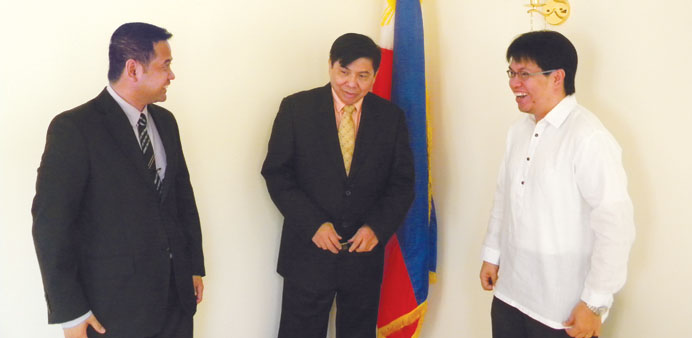
Vice consul Gilbert Segarra (left), ambassador Crescente Relacion (centre) and vice consul Melvin C Almonguera discuss a point at the new Philippine e