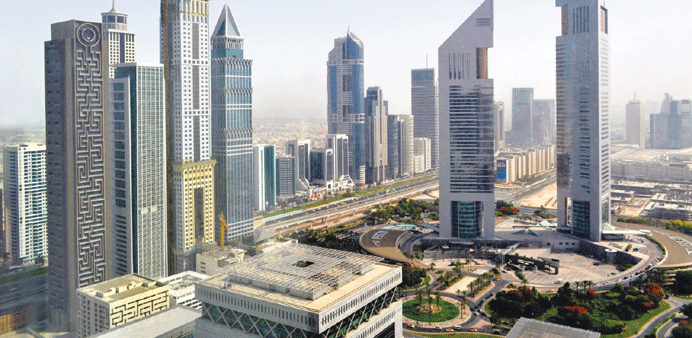
Reuters/Abu Dhabi
Commercial banks in the UAE plan to ask the central bank to delay and soften new rules placing caps on mortgage loans for residential housing, banking industry sources said yesterday.
A central bank circular last week said mortgage loans for foreign individuals should not exceed 50% of the property value for a first purchase of a home, and 40% for second and subsequent homes. The caps for UAE citizens were set at 70% and 60%.
The rules, on which the central bank has not commented publicly, appear to be designed to prevent any repeat of a property market bubble which developed in the mid-2000s, and then burst with disastrous effects on the economy.
But commercial bankers said a fledgling recovery of the property market, which began in Dubai last year, could be slowed by the rules, about which they were not consulted.
The Emirates Banks Association, an industry body, met yesterday to discuss its response to the circular, the industry sources told Reuters, speaking on condition of anonymity because of the sensitivity of the issue.
“It was agreed that the EBA will write to the central bank requesting a 30-day delay for implementation of the circular,” said one source with knowledge of the matter.
In addition, the EBA will by next Sunday prepare a proposal that is likely to ask the central bank to raise the mortgage caps for first-time buyers to 60% for foreigners and 80% for local citizens, the sources said.
Bankers are generally comfortable with the central bank’s caps on mortgages for second and subsequent homes, a second source said.
Foreigners account for about 80% of the UAE’s population of roughly 8mn and are major buyers of real estate in designated areas where they are permitted to own property.
The central bank’s announcement of its rules initially pushed down the share prices of real estate developers. But the effect was short-lived, suggesting investors do not think the regulations will end the property market’s rebound - and also perhaps that they believe the rules may be watered down.
Shares in leading Dubai property developer Emaar Properties initially fell 1.6% but are now 5.2% higher than they were before the announcement.
The central bank has previously tried to regulate the lending of commercial banks, only to back off after the banks protested. It announced last April that from September 30, banks would have to limit their exposure to state-linked entities; some big banks were above the limits when the deadline passed, and last month the central bank said it was suspending the rules while it consulted banks.
Business indicator at 19-month high
Growth in the UAE’s non-oil private sector rose to a 19-month high in December as new orders increased sharply, a survey showed yesterday.
The HSBC UAE Purchasing Managers’ Index, which measures the performance of the manufacturing and services sectors, climbed to a seasonally adjusted 55.6 points last month from 53.7 in November.
A reading above 50 points in the survey of 400 private sector firms means the sector is expanding. High oil prices, a booming tourism industry and the beginning of a recovery in Dubai’s property market, which crashed in 2009-2010, helped the UAE economy last year.
“It is a fitting reading to mark the end of a strong recovery year for the UAE,” said Simon Williams, chief economist for the Middle East at HSBC.
“Good output growth, firm new orders from home and abroad and a pick-up in job creation point to an economy that is growing at a solid pace and well-placed to maintain momentum.
“While the UAE will still likely lag some of its neighbours, the economy enters 2013 at its most positive in five years.”
The survey showed output growth rose to 56.3 points in December, also a 19-month high, from 53.5 in November.
New orders rose at their fastest rate since the survey was launched in August 2009, with around 38% of respondents reporting an increase in new business flows.