


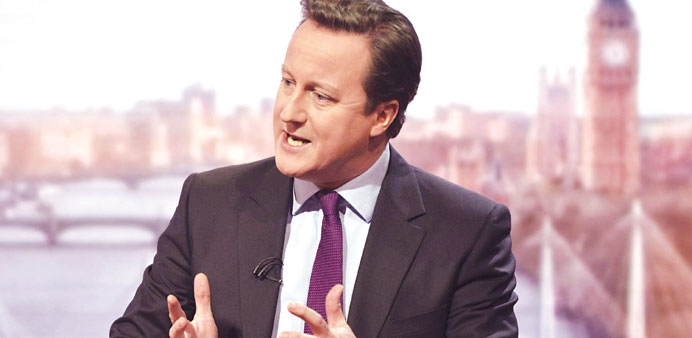
Prime Minister David Cameron speaks on the BBC’s Andrew Marr Show in London yesterday.
Agencies/London
David Cameron yesterday said he wanted to serve as prime minister until at least 2020 to oversee a range of reforms including a renegotiation of Britain’s relationship with Europe.
In a raft of interviews ahead of a midterm review of the progress of his coalition government today, Cameron also defended a largely unpopular decision to remove child benefit payments from higher earners.
Cameron told the Sunday Telegraph he intended to lead his Conservative Party to victory in the 2015 general election and then serve a full five-year term.
As Cameron rarely speaks about his planned departure date, it has prompted speculation that if re-elected he would stand down halfway through his mandate.
But when asked by the newspaper if he intended to stay on as prime minister until 2020, Cameron said: “I want to fight the next election, win the next election and serve - that is what I want to do.”
Pressed on what he would say in a major speech on Britain’s strained relationship with the European Union that he is due to give in mid-January, Cameron said his party would offer voters a “real choice” at the 2015 election.
He said any vote on Britain’s relationship with the EU would happen in the five years after the election, but he refused to be drawn on whether a poll would include the question whether Britain should remain in the bloc.
“People should be in no doubt that the Conservatives will be offering at the next election a real choice and a real way giving consent to that choice,” he said in an interview on BBC TV.
He stressed it was in Britain’s economic interest to remain a full member of the EU to enable the country to influence the direction of the single market.
“If we were outside the EU all together, we’d still be trading with all these EU countries, but we’d have no say over the rules of the market into which we sell,” Cameron said.
He said that because the countries using the euro were forced to make changes to their relationship to bolster the currency, Britain was “perfectly entitled” to ask for changes to the conditions of its membership.
On the domestic front, Cameron insisted there would be no U-turn to a move due to kick in today to remove child welfare payments from families in which one parent earns more than £60,000.
Defending the government’s latest bid to slash the deficit through cuts in public spending, Cameron said: “I’m not saying those people are rich, but I think it is right that they make a contribution. “This will raise £2bn a year. If we don’t raise that £2bn from that group of people - the better-off 15% in the country - we would have to find someone else to take it from.”
Cameron also stressed that the credibility of his deficit-cutting policy was more important than the judgment of credit rating agencies, as the threat of third recession since the financial crisis looms.
Britain has held onto its top triple-A credit rating while the US and France have suffered downgrades, but that endorsement has looked increasingly shaky as the economic outlook darkens.
A loss of the rating would be a blow to Cameron and his Conservative-led coalition, which has staked its political reputation on maintaining the top rating and nursing the economy back to health by cutting its deficit.
Cameron told BBC television yesterday the opinion of the international debt markets was more significant than a credit rating. “What matters most of all is are you able to pay your debts, maintain your debts at a low rate of interest,” he said.
“The ratings you have are all hugely important, but in a way the real test is, what are the interest rates the rest of the world is demanding in order to own your debt.”
Ministers have been increasingly playing down the significance of credit ratings as the economy struggles and the crisis in the euro zone, Britain’s largest trading partner, reduces the near term prospects for growth. Cameron said the key to keeping the faith of financial markets was the government’s programme of cutting state spending to bring its deficit under control. “You can only keep your interest rates low if you have a credible strategy for getting on top of your deficit and getting on top of your debt,” he said.
Cameron also dismissed Ukip as Nigel Farage, the party’s leader, claimed the Conservatives have let voters down like a “cheap pair of braces” because there has been no referendum on Europe.
The prime minister has previously referred to Ukip members as “fruitcakes, loonies and closet racists”, even though many polls now show the party has overtaken the Liberal Democrats in popularity.
Asked whether he would withdraw the comment, Cameron added a fresh insult. “There are some pretty odd people,” he said.
Ukip once offered to stop opposing the Conservatives in return for a promise “written in blood” of a referendum on Britain’s membership of the EU.
However, Farage withdrew this deal in the face of hostility from the prime minister. The Ukip leader yesterday said a pact with Cameron is very unlikely but conceded he would consider a “deal with the devil” if it lead to British voters having a say on the EU.
He also brushed off the latest remarks from the prime minister. “It shows how disconnected he is,” he said.
“If he wants to go on being rude about me and rude about Ukip well let him do it, we won’t lose any sleep over it. I don’t think there is any prospect of any deal with the Conservative Party all the while that man leads it, given the way he has behaved and his attitude towards us.
“But look, I would do a deal with the devil if it got us what we need, which is a free and fair referendum so that we in this country can decide who governs us.”
Polls show a surge in support for Ukip, which is now gaining between 7% and 16% of the overall vote. A new survey by Survation for the Mail on Sunday suggested Farage’s popularity could cost the Conservatives 51 seats at the next election, giving Labour a majority of 94 seats.
UK ‘would fight to keep the Falklands’
Prime Minister Cameron said Britain was prepared to fight militarily to keep the Falkland Islands if necessary, in the face of renewed Argentinian rhetoric over their future. Cameron said Britain had “strong defences” in place on the islands and fast jets and troops were stationed there. Cameron insisted he was “absolutely clear” that Britain would defend the islands with military force. In an interview on BBC TV, he said: “I get regular reports on this entire issue because I want to know that our defences are strong, our resolve is extremely strong.” Asked if Britain would fight to keep the islands, he replied: “Of course we would and we have strong defences in place on the Falkland Islands, that is absolutely key, that we have fast jets stationed there, we have troops stationed on the Falklands.” Cameron said this week that the 3,000 residents of the Falklands had a strong desire to remain British and would have a chance to express their views in a referendum on their political status to be held in March.