


By Ashraf Padanna/Kochi
|
|
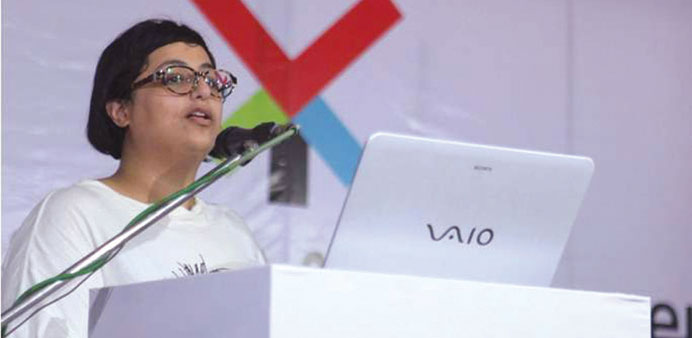
Sharjah Art Foundation president Sheikha Hoor al-Qasimi made a presentation yesterday on the upcoming Sharjah Biennale at the maiden India biennale which opened here last month.
She explained the aesthetic and organisational aspects of the Sharjah biennale which debuted in 1993. The new edition would open in March and has 103 artists participating.
Hoor arrived at the main venue of the Kochi-Muziris Biennale on Friday, along with Sharjah Biennale curator Yuko Hasegawa, and appreciated the efforts of its organisers.
According to the organisers, the two guests expressed their appreciation with what they saw at the main venue of the festival which they felt has given a platform for several artists across the globe who are not familiar names in the biennale circuit. “Thank you @KochiBiennale for a hospitable welcome, if you haven’t visited yet. ends March 13, the day @SharjahArt Sharjah Biennale opens,” she later wrote on the micro blogging site Twitter.
Before their session, senior bureaucrat Amitabh Kant, one of the architects of Kerala’s tourism growth story, delivered a talk in which he said India has yet to exploit its full potential as a tourist destination.
He cited a set of tourism programmes he spearheaded and supporting it with video clippings, showed how they found success in boosting the image of the state and the country as a cultural destination.
Among them were campaigns such as God’s Own Country and Incredible India, besides those meant to give training to guides as well as taxi drivers, and creating awareness among people about preserving heritage sites and tourist resorts in the locality.
Lecturing on ‘Brand India’ at the Aspinwall House in Fort Kochi, Kant, who currently heads the Delhi-Mumbai Industrial Corridor, said records showed an average of 30 people in India moving every minute from villages to urban areas in search of a livelihood.
“The tourism segment is what aids their job prospects. There are ways to boost it. We have to use them well,” the bureaucrat pointed out in the biennale’s ‘Let’s Talk’ series. “We brand our land not as an advertisement, but as an experience.”
Endeavours like the biennale can give fresh energy to the country’s tourism sector, Kant said, while wishing it success.
Federal minister Dr Shashi Tharoor is the speaker in the next series. He will speak about ‘Globalisation and Human Imagination’ tomorrow, the organisers said..
On Friday, Kant’s successor Dr Venu V appeared in the talk series and said the biennale is one of the finest examples of successful implementation of a public-private partnership project in the country.
The monetary aspect of the three-month festival was based on a model where public money was spent before its start on 12.12.12 and private funds being used subsequently, the Joint Secretary to the Department of Culture, Government of India, said.
Dr Venu, who is one of the main individuals behind India’s first biennale, said he could agree with the 2010 proposal from artists Bose Krishnamachari and Riyas Komu — both as an official associated with Kerala’s tourism as well as a person involved in cultural activities.
“For one, I could grasp the positive effects that a biennale could bring to the state in general and Kochi in particular,” he said.
Kerala’s tourism sector has always been on the frontlines when it came to new offbeat ideas, and the biennale looked like another promising step in that direction, he added. The official, who had a detailed look at the exhibits at the main venue of the extravaganza, said he knew well about the biennale’s potential to benefit Kerala’s artists.
“Through debate, it has lent a new dimension to our aesthetic sensibilities,” he noted, adding that the event has been gratifying even though some of his original aims have remained unaccomplished.
The Union government’s budget, he said, earmarks only 0.2% of expenses towards cultural matters. As for Kerala, the allocation is still poorer. Given that, only PPPs can ensure implementation of ideas like the biennale, he maintained in the talk titled ‘Public-Private Partnership in Heritage.’
Private support to heritage conservation and growth of the arts need not be derisively branded as a “corporate” activity, added Dr Venu, who is also associated with theatre.