


Staff Reporter
 |
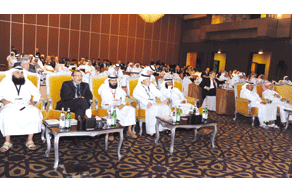
| Some of the speakers and a section of the audience seen during the summit yesterday |
The initiative being organised by the French business information company ‘naseba’, is in partnership with the Qatar Environment and Energy Research Institute (QEERI).
Participants at the event are also discussing upcoming developments in the Middle East and North Africa (Mena) region, as well as effective investment vehicles for global green energy projects.
In a keynote address, European Investment Bank’s Global Energy Efficiency and Renewable Energy Fund head (Geeref) Cyrille Arnould emphasised the importance of understanding clean energy finance in the emerging markets by highlighting how obtaining funding for small to medium-sized projects remains difficult.
He explained why funds such as Geeref help bridge the financing gap, in addition to supporting the emergence of a new class of fund managers dedicated to the renewable energy asset class.
“Clean energy is vital. However the key challenge is to identify which business models are scalable, and will effectively bring the resources needed to implement renewable energy projects in developing and developed countries,” he stated.
Arnould noted that the developing countries may benefit in the long run, given the need to build infrastructure from scratch.
“This will ensure they (developing countries) are not inheriting dumb grid and dirty production assets so they can focus on building a smart grid for more effective generating capacity,” he added.
Another keynote speaker, Saudi-based King Abdullah City for Atomic and Renewable Energy (Kacare) chief strategist Dr Ibrahim Babelli said due to its growing needs and demand for energy, Saudi Arabia will obtain the use of three most important alternative energies namely: fossil energy, nuclear energy and renewable energy despite having the world’s largest oil reserves.
He mentioned that the 5mn households presently in Saudi Arabia are expected to double by 2030.
“The kingdom consumes large quantities of oil as our demand has grown by more than 125% in the past four years because we need to fuel more companies and power our turbines for water desalination and due to this, our energy reserve will deplete badly in the next 30 years if we refuse to take a decisive step right now,” he noted.
He maintained that the three means of alternative energy are safe, reliable and costs effective apart from having excellent renewable sources, low green house gases emissions as well as promising financial outlook.
Dr Babelli attempted to debunk the fear associated with the nuclear energy use, especially after the disaster in Fukushima, Japan, claiming that the technology is the safest and highly advanced source of energy.
“There are risks in every venture and once we are able to quantify the risks surrounding having a nuclear energy facility as well as put in place proper safety measures, we should be able to minimise these risks, which usually do not occur anyhow,” he maintained.
Other speakers at the seminar included QEERI executive and founding director Dr Rabi Mohtar and its Solar Desalination principal investigator Dr Mohamed Darwish, Greener Capital managing director and general partner Michael Katz.
Among the pioneering companies, which presented their investment opportunities at the event yesterday was Bamboo Finance, a commercial private equity asset manager specialising in impact investments.
The company also announced the launch of their Bamboo Global Energy Fund, ‘Solar for All’ - the first global fund focusing on solar energy companies serving low-income markets.
There was also an interactive panel discussion, which examined a variety of investment strategies for large-scale developments, featuring Green Gulf Inc chief executive officer Omran al-Kuwari and Masdar’s Origination and Asset Management head Daniel Calderon.