By Bonnie James
Deputy News Editor
As many as 84mn people are likely to die of cancer over the next 10 years, with over 70% of them in the developing world, acclaimed chemistry researcher Prof Princess Chulabhorn Mahidol of Thailand said yesterday.

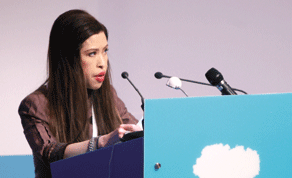
Prof Princess Chulabhorn
“More than 80% of these cancers will be caused by environmental and lifestyle factors, especially through carcinogenic compounds present in air, water and food,” explained the founding president of the Chulabhorn Research Institute.
She was giving a keynote presentation on ‘Environmental Carcinogens: Exposure and Impacts on Children’s Health,’ at the Sixth International Conference on Environmental Mutagens in Human Populations.
Pointing out that children are more susceptible than adults to the action of environmental carcinogens that induce DNA damage, the speaker observed that environmental factors play a major role in determining the health and well-being of children who comprise over one third of the world’s population.
Prof Princess Chulabhorn highlighted the gravity of the situation by citing the WHO finding that 5mn children die every year from illnesses that relate directly to environmental conditions and the Inter-Governmental Forum on Chemical Safety’s report of 13,000 child deaths daily.
Children are among the most susceptible to chemical toxicity, particularly to carcinogenic compounds, due to behavioural and physiological reasons, including hand-to-mouth actions and a lack of understanding of potential dangers. Asthma and childhood cancer are now on the rise in developed countries. In the US, cancer is the second biggest killer of children in the 5-14 age group, after road accidents.
“Carcinogenic compounds in the environment are a major threat, with arsenic contamination of ground water and benzene and polycyclic aromatic hydrocarbons in the air among the major issues,” said Prof Chulabhorn.
Arsenic, a ubiquitous environmental pollutant, is a Class I human carcinogen. It is estimated that 140mn people in the developing world are exposed to arsenic polluted drinking water, which exceeds the 10 micrograms per litre limit of WHO. This includes more than 30mn in Bangladesh, 40mn in India, 1.5mn in China, and 2.5mn in the US.
The WHO warns that long term exposure to arsenic in ground water at a concentration in excess of over 500 micrograms per litre causes cancer death of one in 10 persons.
US Environmental Protection Agency and the Natural Resources Defence Council have recommended an arsenic level below one microgram per litre to attain an acceptable lifetime cancer risk.
The youngest daughter of King Bhumibol Adulyadej and Queen Sirikit of Thailand, Prof Princess Chulabhorn pointed out that prenatal arsenic exposure in the human population results in alarming gene expression changes in newborns.
“Prenatal exposure to arsenic - which could include exposure of mother, foetus or young child - may affect the onset of diseases in adulthood, such as cardiovascular and neurodegenerative diseases or cancer,” she said.
Exposure to arsenic during early childhood causes problems in children, including neuro-behavioural deficits and a lack of intellectual development.
Quoting a Thai study, Prof Princess Chulabhorn - the third person in the world to be awarded Unesco’s Einstein Gold Medal for her continuous effort in promoting scientific collaboration in Asia and the Pacific – said children in urban areas are more exposed to atmospheric pollutants.
“Children have lower DNA repair capacity than adults,” the speaker stated while adding that a clean environment is essential for the good health of children.
A Professor of Chemistry at Mahidol University, Princess Chulabhorn’s special research interests are in the chemistry of natural products and in Thai medicinal plants, environmental health problems of developing countries and cancer research.
The first Asian to be invited to join the Royal Society of Chemistry, in England, as an Honorary Fellow, she was special advisor to the UN Environment Programme and member of the Special High-Level Council for the International Decade for Natural Disaster Reduction of the UN.
She has also been a visiting professor at universities in Germany, Japan and the US, and has received numerous honorary doctoral degrees from universities across the world.
Doha conference a ‘first’ for Gulf
Nearly 350 delegates including leading scientists and researchers from the region and around the globe are attending the ongoing Sixth International Conference on Environmental Mutagens in Human Populations.
A first for the Gulf region, the event concluding tomorrow is being hosted by Qatar Foundation for Education, Science and Community Development in association with Environmental Mutagen Society and the International Association of Environmental Mutagen Societies (IAEMS).
It is part of a series of international conferences designed to identify solutions for important human health problems caused by environmental factors.
In his welcome address yesterday QF president Dr Mohamed Fathy Saoud, highlighted the organisation’s role in driving Qatar from a carbon-based to a knowledge-based economy.
Recalling HH the Emir, Sheikh Hamad bin Khalifa al-Thani, allocating 2.8% of the GDP annually to science and research since 2006, Dr Saoud pointed out that this unique dedication of a vast resource has placed Qatar at the forefront of research efforts.
“This is complementing Qatar-based developments with international expertise, building networks that can provide home grown solutions with global repercussions.”
On the particular importance of the conference for the region, Dr Saoud observed that “despite our focused efforts in this field, there still is a long way to go, as the study of environmental health is still underdeveloped in the Arab world.”
“This conference aims to bring environmental health to the top of the regional research agenda and to benefit the region as global scientific developments and knowledge will be shared and opportunities for networking and further collaboration will be established.”
Dr Wiliam Au, co-chair of the Conference and chairman of Shantou University Medical College in China, and Dr Stefano Bonassi, president of IAEMS, also welcomed the delegates.
Dr Saleh al-Marri, assistant secretary general for medical affairs of the Supreme Council of Health addressed the conference on behalf of its largest sponsor.
A highlight of the opening session was the keynote presentation by Professor Princess Chulabhorn Mahidol of Thailand, who spoke on the impact of environmental factors causing cancer among children.
Professor William Dab of the French National Institute of Science, Technology and Management and Professor Michel Aubier of Bichat University Hospital in Paris spoke on new developments and challenges in assessing the effects of pollution on human health and on traffic-related pollution’s effect on respiratory diseases.
Earlier during the morning session, QF’s vice president of research Dr Abdelali Haoudi, honoured Prof Princess Chulabhorn, Dr al-Marri, and Dr Au.
The top three abstracts from students or junior investigators will be awarded prizes awarded at the closing ceremony.