


By Bonnie James
Deputy News Editor
The Sixth International Conference on Environmental Mutagens in Human Populations (ICEMHP 2012), which begins today in Doha, has been described as a significant event to learn from experts on how to ameliorate the effects of contaminants on human health.

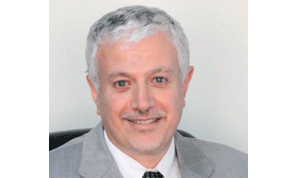
Dr Rabi Mohtar
“While most developed countries are extremely concerned about the effect of pollutants on human health, such actions are delayed in the Gulf region,” Qatar Energy and Environment Research Institute executive director Dr Rabi Mohtar told Gulf Times.
The main concern is that some of those pollutants may lead to cause mutations which could result in cancer and birth defects, he explained while pointing out that some actions are underway in Qatar in this regard.
“The Ministry of Environment and the Supreme Council of Health are preparing new standards for pollution control and impacts on health relating to air, water, the sea, industrial wastes, destruction of waste material notably chemical and hospital wastes, and determining what materials are acceptable for recycling and re-use in construction and industry in Qatar,” Dr Mohtar stressed.
Hosted at Qatar National Convention Centre by Qatar Foundation, the Environmental Mutagens Society, and the International Association of Environmental Mutagen Societies, the conference is aimed at promoting collaborative research in understanding the relationship between environmental factors, DNA mutation, and human disease.
Dr Mohtar emphasised that there were different types of contaminants, both natural and human-made. The natural pollutants come with dust and wind whereas those from humans originate sources including the oil-gas industry, factories, quarries, paints, cleaning products, and agricultural fertilisers.
They can be found in the air, dust, water, wastewater, soil, food, clothes, toys, and many others. Noise and light are also environmental contaminants.
Toxins from cyanobacteria present in the desert environment may also pose a risk to human health, and scientists from Weill Cornell Medical College in Qatar will give two presentations at the conference on this topic.
Different types of contaminants and toxins affect the human health in different ways, levels and scales, and can induce changes in the physiology, psychology and behaviour of human populations.
“In Qatar, because of its specific position in the hydrocarbon industry, the Qatari environment (air, water & soil) and therefore its human community and ecosystems, are prone to several pollutants produced during all phases of oil/gas production,” Dr Mohtar said.
“These pollutants include, BTEX (a mixture of benzene, toluene, ethylbenzene and xylenes) which are carcinogenic and cause serious problems in the reproductive, respiratory, nervous, cardio-vascular and neurological systems.
“Similarly, there are several others, such as diesel fuels, hydrogen sulfide, heavy metals, polycyclic aromatic hydrocarbons, particulate materials, sulphur dioxide, volatile organic compounds, all of which cause lots of health problems.
“Contaminants also impact the health of the natural environment, including animals, plants, soils, landscapes, and the sky, among others.”
Dr Mohtar clarified that Qatar, a very small country, was under the influence of different sources of pollution coming from different directions and countries.
“In QEERI, a QF centre, we are planning to investigate the environmental and ecosystem status of Qatar’s sea and coast in order to determine the major sources of water and sediment contamination.