


By Bonnie James
Deputy News Editor
Hedgehogs 007 and 009 did not turn up. But 008, 82, 115, 49 and 145 did. The action at the ‘hedgehog night club or smelly mound’ gathered pace gradually.

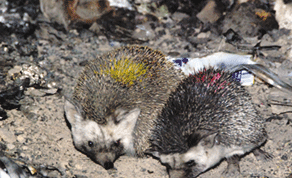
A male hedgehog courts a female at the ‘hedgehog night club.’ PICTURES: Dr Nobuyuki Yamaguchi
The location was a refuse dump in the vicinity of the Qatar University Farm at Rawdat Al Faras, about 60km north of Doha.
“As many as 160 Ethiopian hedgehogs have been identified as living and roaming in a 4x4km area, including the farm and the smelly mound,” Dr Nobuyuki Yamaguchi told Gulf Times.
An assistant professor in Animal Ecology, Department of Biological and Environmental Sciences, Qatar University, he has been visiting the farm since April 1, 2010, as part of research on the species.
All the 160 hedgehogs identified so far have been given nail polish markings in various colour codes. It takes only a few moments for the researcher to identify them.
Dr Yamaguchi is very familiar with the peculiarities of certain hedgehogs. For instance, 009, the first radio-tracked Ethiopian hedgehog in the world, is an over three-year old male adult who would not curl up, unlike others, if picked up.
“008 and 49, both males, are residents of the QU Farm, who makes regular nocturnal visits to the smelly mound,” the researcher said after finding them rummaging through the waste dump.
A total of 10 hedgehogs are radio tagged for research and we came across number 115, a female tagged since November 2011.
Hedgehogs sleep during the day and roam around at night, sometimes covering several kilometres, in search of food and mates.“They usually eat small invertebrates, but here at the dump I have seen them eating leftover fried chicken,” Dr Yamaguchi said while revealing that hedgehogs are not immune from the fast food culture prevalent in Qatar.
During the mating season, male hedgehogs mate with as many females as possible, even foregoing food and some even die, possibly from exhaustion.
“One male whose body weight peaked at 600gm during winter, dropped to 440gm in a month, most probably due to the intense mating sessions neglecting food,” he observed.
Both male and female hedgehogs become sexually active after they are one year old. Females give birth twice or thrice a year.
Hedgehogs are easily recognised by their spines, which are not poisonous or barbed and, unlike the quills of a porcupine, cannot easily be removed.
A main characteristic of all species of hedgehogs is the ability to roll into a tight ball, causing all of the spines to point outwards, when they feel threatened. Birds like owls and animals like foxes and wolves are known to prey on hedgehogs, which sleep for a large portion of the daytime either under cover of bush, grass, rock or in a hole in the ground.
Different species can have slightly different habits, but in general hedgehogs dig dens for shelter. All wild hedgehogs can hibernate, although not all do; hibernation depends on the temperature, species, and abundance of food.
From the observations made so far in Qatar, it has been learnt that the extreme summer heat is not a problem for the hedgehogs as they are well adapted to the desert environment.