


By Bonnie James
Deputy News Editor
The first ever detailed study of the behavioural ecology of free-ranging Ethiopian hedgehogs in the natural environment is to be published in scientific journals in the near future by a faculty member from Qatar University.

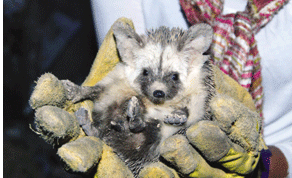
An Ethiopian hedgehog cradled in the gloved hands of a volunteer
“It will shed light on the interesting life of the Ethiopian hedgehog, the only indigenous hedgehog in Qatar,” Dr Nobuyuki Yamaguchi, assistant professor in Animal Ecology, Department of Biological and Environmental Sciences, told Gulf Times.
Though the hedgehog is one of the most familiar animals in Europe where they are also well studied, they have not attracted much attention in the Middle East, including Qatar, notwithstanding that there are twice as many hedgehog species in the region than in Europe.
“When I came to Qatar in 2007, practically nothing was known in terms of ecology and behaviour of the Ethiopian hedgehog (Paraechinus aethiopicus),” the researcher recalled.
Between 2007 and 2008, Dr Yamaguchi and a student from his department conducted a study on the hibernation pattern of the Ethiopian hedgehog, using a captive animal.
The results became one of the few research papers ever published on the basic ecology and behaviour of the Ethiopian hedgehog under natural weather conditions.
It was in 2010 that Dr Yamaguchi secured a grant from the Qatar National Research Fund’s Undergraduate Research Experience Programme to start a basic behavioural ecological research on free-ranging Ethiopian hedgehog with two new students.
“Also, I was fully supported by the Department of Biological and Environmental Sciences, which allowed me to use the field station at the Qatar University Farm at Rawdat Al Faras, about 60km north of Doha,” he said.

Dr Nobuyuki Yamaguchi
The QU Farm is the only biological-agricultural research facility associated with any academic institution in Qatar. Dr Yamaguchi and his students conducted the world’s first radio-tracking study on the free-ranging Ethiopian hedgehog in April 2010.“The first radio-tracked Ethiopian hedgehog in the world, a male adult identified as 009, is very active as of this month,” the researcher said.
A preliminary analysis of the radio-tracking results was carried out in early 2011, suggesting that Ethiopian hedgehogs in Qatar may have, on average, the largest home range in any hedgehogs that have so far been studied.
The results were presented in The UK Mammal Society’s Easter Conference in Nottingham, UK, in April 2011, which Dr Yamaguchi and a student attended with support from QU’s student exchange section.
Hedgehog radio-tracking and population monitoring are continuing. Throughout this winter, between November 2011 and February 2012, Dr Yamaguchi has stayed in the field station at the QU Farm between Tuesday and Saturday every week.
“My colleagues told me that I am “brave” to live in such a remote place “alone” and to work “alone” at night! It is true that there is no TV, no Internet connection, and no social life there.
“Also I work between 4pm and 6am, often walking alone in the cold and dark night. However, this is what wildlife researchers do – working in harsh conditions to study what we are interested in.”
Dr Yamaguchi is also a member of the International Union for Conservation of Nature Cat Specialist Group, African Lion Working Group.