By Fran Gillespie/Doha
The Museum of Islamic Art, Doha (MIA) yesterday inaugurated a new exhibition: Gifts of the Sultan: The Arts of Giving at the Islamic Courts. Previously on display at the Los Angeles County Museum of Art (LACMA) and in Houston, this is a major international loan exhibition which explores Islamic art through the tradition of gift giving.
The exhibition is presented by the MIA, in collaboration with LACMA and with support from the Museum of Fine Arts, Houston. Featuring more than 200 works of art, of which 16 objects from the MIA collection are on display for the first time as well seven from its regular exhibition, it covers a rich variety of media across all periods from the 8th century to the present day.
Among the highlights on show is an impressive selection of objects from The State Historical and Cultural Museum Preserve (The Kremlin), Moscow, and The State Hermitage Museum, St. Petersburg.
These works appear alongside loans from more than 30 major collections and museums around the world, including the Los Angeles County Museum of Art and the J. Paul Getty Museum, Los Angeles; the Metropolitan Museum of Art, New York; the Museum of Turkish and Islamic Art and the Topkapi Sarayi Museum, Istanbul; the British Museum, the British Library, and the V&A, London; The Aga Khan Museum Collection, Geneva; and the Museum of Islamic Art, Berlin.
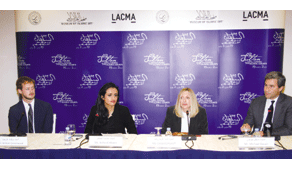
Linda Komaroff, the curator of the exhibition, said yesterday at a media conference: “This exhibition gives us a new way of looking at Islamic art through the theme of gift giving. The exchange of gifts played a major role in the art of diplomacy, and were intended to impress the recipient. Objects were often re-gifted, moving from court to court, and in this way courtly art was transmitted across international boundaries.”
Such was the demand for ornate and impressive gifts that a whole industry existed of fine craftsmen to provide them. Of the objects in the exhibition, said Komaroff, 75% have documentation proving that they were made specifically to be gifts, and the rest are “gift-type” objects.
Gifts of the Sultan is organised in three sections: personal gifts, pious donations, and state and diplomatic gifts. The first section includes objects of personal adornment in the form of jewellery, belts, and garments; precious yet utilitarian pieces, such as vessels of gold, silver, porcelain, and jade; as well as paintings, albums, and manuscripts.
The second section highlights “pious” gifts, encompassing not only such objects as manuscripts of the Qur’an endowed to religious institutions, but also works of a secular nature that were gifted to a mosque or shrine. Among the most impressive of these is a large silk and wool Ardabil carpet from the Safavid dynasty of Iran, on loan from LACMA.
The third and largest section features a broad array of works that were presented on state occasions. Gifts in former times had to be of sumptuous quality, whether textiles, precious metals, wood, glass or stone - one gift was an entire palace which was shipped in pieces to be re-assembled at its destination. A far cry, Komaroff pointed out, from the 21st century when President Obama and Queen Elizabeth II recently exchanged an iPod and a picture frame!
As well as objects, gifts often took the form of valuable or exotic animals. Throroughbred horses would be sent complete with richly embossed saddles and jewelled harness, and such curiosities as a giraffe, ostriches and on one occasion a rhinoceros were gifted. Often the recipient after a decent interval would pass them on – a classic example of the proverbial “white elephant”.
The exhibition includes examples of an elaborately embellished saddle cloth and bridle from 17th century Turkey and naturalistic paintings of an exceptionally valuable elephant gifted to the Mughal emperor Shah
Jahan, and a zebra presented to Emperor Jahangir, taken to India by Turkish traders who transported it from Africa. A giraffe which survived the journey to Iran in the 15th century caused a considerable sensation, and court painters did their best to depict the strange beast.
Aisha al-Khater, Director of the MIA, spoke of the many months of organisation both in Qatar and in the USA that had gone into bringing the exhibition to Doha. “Each country has different procedures for lending art,” she commented, “and it’s been quite a learning experience bringing it all together! This is an excellent opportunity for the community to learn about the history and etiquette of gift giving in Islamic civilisation, and we are excited to be collaborating with LACMA on this very important exhibition.”
The exhibition also includes a contemporary component, presenting the work of Sadegh Tirafkan, Shahzia Sikander, Ahmed Mater, and Günseli Kato. These four innovative artists, who have roots in the Islamic world and draw creative inspiration from their cultural traditions, were specially commissioned to produce new work interpreting the theme of Gifts of the Sultan.
The exhibition will be open from March 21 until June 2, 2012, and the MIA is planning an extensive education programme, including lectures, workshops for children and adults and other activities. Admission tickets to the exhibition are QR25, students and children under 16 are admitted free of charge.