


By Bonnie James/Deputy News Editor
Ahmed Ibrahim Sadeeq Al Emadi Company’s farm, supported by the Qatar National Food Security Programme (QNFSP), is all set to expand its facilities by establishing more greenhouses to boost vegetable production.

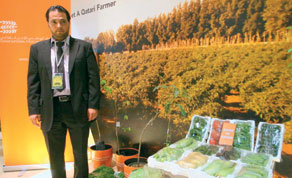
Aziz is seen near a display of vegetables produced at Ahmed Ibrahim Sadeeq Al Emadi Company’s farm. A picture of the farm is seen in the background. PICTURE: Nasar T K
“Our objective is to produce vegetables round the year, with special emphasis on the harsh summer months when only greenhouses work and outdoor cultivation is impossible,” administrator Alaaeddin Abdul Aziz told Gulf Times.
He was speaking on the sidelines of the Third Qatar International Agricultural Exhibition 2012 (3rd AgriteQ 2012), which concludes today. A display of a variety of vegetables from Ahmed Ibrahim Sadeeq Al Emadi Company’s farm is set up at the QNFSP pavilion.
The farm, established five years ago in the Zubarah area, is spread over 160,000sqm. It supplies vegetables to a number of supermarkets, restaurants and other outlets.
“We use only natural fertilisers,” Aziz stated while adding that the rearing of sheep, cow, rabbit and chicken at the farm ensure a steady supply of manure. Organic fertilisers are also bought from outside as well.
The QNFSP is looking to support Ahmed Ibrahim Sadeeq Al Emadi Company’s farm in the packaging of its vegetable produce so as to give it an edge in the market.
Qatar currently produces approximately 23% of its vegetable requirements through green houses and open field cultivation at farms.
The Qatar National Food Security Programme (QNFSP) has indicated that there is scope to increase self sufficiency as well as stimulate a vegetable processing industry.
The average yield is approximately 16 tonnes per hectare for open field crops and 96 tonnes per hectare for greenhouse production.
QNFSP estimates that vegetables are currently grown by 56% of farmers and takes up 11% of cultivated farm land in Qatar.
Established by HH the Heir Apparent Sheikh Tamim bin Hamad al-Thani, QNFSP consists of an inter-governmental task force to develop the food security master plan by the end of 2012.
The objective is to develop a comprehensive and sustainable long term solution to the challenges that the country faces with regards to its food security.
It is intended to increase domestic agricultural production and in parallel strengthen the security of food imports to alleviate the supply deficit that Qatar faces.
The programme will implement the usage of solar energy to desalinate seawater and in turn use it for agricultural production.
It is estimated that given the demographic growth of Qatar, current levels of domestic agricultural output satisfy no more than 10% of total national food consumption needs.
Qatar has 1,216 registered farms with 23,903 hectares of arable land, of which only 12,274 hectares or roughly 51% is actually under cultivation.
The average size of productive farms in Qatar is 27 hectares and on average only about eight hectares are used for crop production, with roughly equal areas devoted to fruit trees, vegetables and fodder crops.