


 |
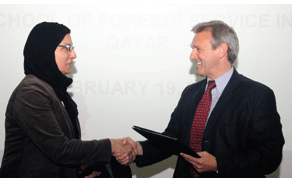
| Prof al-Misnad and Prof Nonneman shake hands after signing the MoU yesterday |
The agreement was signed by QU president Professor Sheikha Abdulla al-Misnad and SFS-Q dean Professor Gerd Nonneman at QU, in the presence of QU vice-president and chief academic officer Dr Sheikha bint Jabor al-Thani, deans, and faculty members from both institutions.
Giving a presentation about the tie-up, Dr al-Thani explained that the exchange of faculty and professional staff will involve a pairing programme for faculty from both institutions.
Faculty will be eligible to teach at both institutions, there are provisions for secondment of faculty for a full semester, exchange of research fellows and a shadowing programme for administrative faculty in the library and student affairs.
With respect to major academic projects, collaboration may be in the form of joint committees which would facilitate exchange of ideas and constructive feedback.
Additionally, SFS-Q may act as a facilitator for collaboration with its parent campus in Washington DC. Both QU and SFS-Q will exchange relevant academic materials and explore new avenues for sharing information resources through advanced technologies.
The cross listing of courses will allow students from both institutions to take courses at each other’s campuses. These courses will count towards fulfilling their degree requirements.
Research collaboration and exchange are to be encouraged through the formation of voluntary research clusters on thematic lines.
“There is also a possibility of holding an annual research retreat for faculty from both institutions,” Dr al-Thani added.
Professor al-Misnad described the MoU as a clear indication of how higher education is evolving in Qatar.
“Collaboration and exchanges form part of the goal to establish a cohesive environment of academic opportunities for students preparing to enter university and those in the process of making final decisions on the studies they want to pursue,” she stated.
Professor Nonneman said the MoU fits Georgetown’s fundamental aim of engaging with the wider Qatari society and education, as part of Georgetown’s own development and mission.
“It simply makes intrinsic sense for our institutions to collaborate. Both of our institutions’ students and faculty will benefit from the exchange of ideas and knowledge, and we hope our exchange of expertise leads to long-term relationships of mutual benefit among teaching faculty, staff and administrative leaders, and will help serve the needs of Qatar and the region,” he added.