


 |
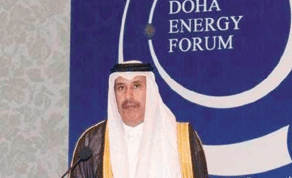
| HE the Prime Minister and Foreign Minister Sheikh Hamad bin Jassim bin Jabor al-Thani addressing the inaugural session of the 2012 Brookings Doha Energy Forum |
“This step should be one of the main priorities of GCC countries”, said the Prime Minister addressing the inaugural session of the 2012 Brookings Doha Energy Forum here yesterday.
He said it is not sufficient that each country works unilaterally on its clean energy plan, adding that despite Qatar’s success in producing 77mn tonnes of LNG in 2010, a more comprehensive plan that covers the GCC’s developmental needs for the next five decades, must be adopted.
HE Sheikh Hamad bin Jassim further said that the world’s oil reserve is 1,200bn barrels, 65% of which is in the GCC. The current consumption of oil is 80mn barrels a day, equivalent to 30bn a year. With the increase in oil consumption in the future, the Prime Minister said that the value of oil will decrease with time as the reserve runs out. Another reason would be finding a cheaper product that is less harmful environmentally, the Prime Minister noted.
HE Sheikh Hamad bin Jassim stressed that moral responsibility towards future generations prompts GCC countries to find new energy products that are more sustainable, in order to achieve sustainable development.
He underlined that any growth, regardless of how big, will be lacking if it doesn’t take the prosperity of future generations into account.
The Premier called on the participants to avoid discussions on the energy price levels since these factors will be determined by the market. They can also be negotiated with Opec, he added.
Elaborating, Sheikh Hamad bin Jassim said that the focus should be directed towards the strategy of the next stage that will follow oil.
The Prime Minister said that energy was never a commodity that was subject to laws of supply and demand only. He said that energy has always been the tool for development and a reason for conflict between all countries.
The world’s biggest industrial countries looked to control the available energy resources, he said.
HE Sheikh Hamad bin Jassim further said that efforts made by the industrial countries to find new sources of energy must act as a guide to what the oil producer’s next step should be. He added that fear of using nuclear energy as a substitute for oil grew after the Chernobyl crisis, which prompted industrial countries to research new and safer sources of energy.
He said any observer of the research efforts can conclude that the future in the next 30 years will belong to clean and sustainable energy, pointing to the French government, which began the work on a 10bn euro project to produce solar energy.
The German government announced that it will stop using traditional fuels by the year 2050, the Premier said, adding that such efforts come at a time when American scientist Craig Venter made significant discoveries of producing energy using bacteria.
The Prime Minister noted that the previous scientific researches were accompanied by a significant increase in clean energy investment. The total investments in clean energy in 2009, the Prime Minister said, were worth $186bn. In 2011 it reached $260bn. He expects the total investment in clean energy to reach $600bn by 2030.
Concluding his address, the Prime Minister expressed his trust in the participants’ abilities to come up with the right recommendations in the field of energy, that would benefit the GCC region.
Besides HE the Prime Minister and Minister of Foreign Affairs Sheikh Hamad bin Jassim, the conference was also attended by HE the Minister of Energy & Industry Dr Mohamed Saleh al-Sada.
The conference includes representatives of more than 15 countries from around the world concerned with the energy sector. They are to hold talks on issues affecting the energy market globally in terms of the changes the Middle East has been witnessing.
The conference aims at setting recommendations contributing to enhance the energy market globally through the challenges such a sector faces.
The key points of the two-day conference include “The impact of Middle East revolutions on the global market of energy”, “Middle East’s investments in the field of energy”, and “The changes the energy markets witness.”
Vice-president and director of the Foreign Policy Programme at the Brookings Institution, Martin Indyk, in his address stressed the importance of the Brookings-Doha energy conference 2012 that brings together leaders of the US and Middle East to discuss key issues concerning energy market, expressing hopes that the conference would be held annually. He noted Qatar’s role in the global energy market and its contribution in securing energy supplies around the world.
Vice-president of ExxonMobil Andrew Swiger in his address pointed out that natural gas will be the second largest energy resource consumed in the world by year 2025 due to its positive environmental features.
He expected a 40% increase in the demand for natural gas in the coming years compared to 20 % now.