


 |
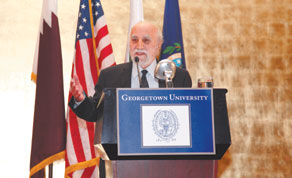
| Ajami addressing Georgetown University students |
The event, which was sponsored by Georgetown’s Center for International and Regional Studies (CIRS), took place at the university’s campus and drew its audience from the community in Doha.
The lecture – ‘Tracking the Arab Spring, The best day after a bad emperor is the first’ – explored how the Arab awakening started in Tunisia, went on to Egypt and then to other countries including Syria and Libya.
Ajami described how the Arab Spring started when the self immolation of Mohamed Bouazizi, a Tunisian street vendor, became the catalyst for the Tunisian revolution that spread to other countries in the Arab world.
“Arabs, for several decades walked by the wall and did nothing against these tyrannical regimes, but now they are eager to take their freedom and full rights. They have decided to react to these regimes,” Ajami told his audience.
Ajami is a Lebanese-born American university professor and a frequent contributor on the Middle Eastern issues and contemporary international history to the New York Times Book Review, Foreign Affairs, The New Republic, The Wall Street Journal, among many other journals and periodicals.
For him the Arab Spring is a special political phenomenon. “I am all in with the Arab Spring, I believed in it and still do. However, I am really worried about Egypt. If the Arab awakening does not succeed in Egypt, it will affect the political, social and economic situations in other Arab countries.”
“The economic freedom is linked to the political one, there is no political freedom in the absence of economic freedom,” explained Ajami.
Georgetown University’s CIRS hosts a variety of regional and international experts through their Distinguished Lecture Series, with former speakers including prominent Middle East news correspondent Robert Fisk and Pulitzer Prize-winning author Thomas L Friedman. These lectures are designed to raise awareness of regionally-relevant international issues.