


 |
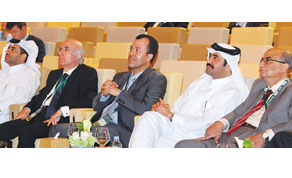
| HE al-Sada alongside QF vice-president Dr Fathy Saoud, QF vice-president for Research Dr Abdelali Haoudi and others during a session at the ARF yesterday |
The two most significant issues in the process of research development are the quality of research and collaboration efforts, HE the Minister of Energy and Industry, Dr Mohamed bin Saleh al-Sada, said during a keynote address at the Qatar Foundation Annual Research Forum (ARF) yesterday.
“Collaboration is an important factor for the success of research as it relates directly to building and sharing knowledge and is strongly linked to learning. Research involves high level of uncertainty and even ambiguity and collaborative efforts are also about sharing risk,” he noted.
Al-Sada stressed the need to continuously keep an eye on the development and update of new partnership models through collaborative networks, saying that advances in communication and information technology have driven the globalisation at large, and that to succeed in globalisation of research, there was the need to add international partnerships and collaboration.
“Quality in the research is very important. A knowledge-based economy implies world class knowledge which in turn needs world-class research. We already have the presence of academic institutions at the Hamad Bin Khalifa University and major companies at the Qatar Science and Technology Park. We expect the industry to bring their world class research to Qatar and at the universities we will need to see research at the PhD level to support this,” he noted while pointing at knowledge-based development and new technology as the biggest challenge for Qatar’s oil and gas business’ future.
“The first and critically important step for the transfer to a knowledge-based economy must begin with the transformation of the oil and gas business in Qatar into a knowledge and technology driven business,” he stated mentioning that Qatar Petroleum has taken some key steps in that direction by establishing a research and technology centre to align QP’s technical competency to its future technology requirements.
“Technology is our ally in the development of products and systems to preserve our biodiversity and ecosystem. Science and research will continue to play an important role in developing our understanding of the sensitivities of the environment in which we live. The research community and this forum can play a special role in recommending measures for identification of potential impacts of environmental and social risks,” he maintained.
Another keynote speaker at the event, Lawrence Berkeley National Laboratory director Dr Paul Alivisatos, who spoke about nanoscience research and carbon cycle, said Qatar could become the hub of global science research in 2030.
“With Qatar’s open and international outlook and being the global hubs for energy (natural gas), communication (Al Jazeera), transportation (Qatar Airways) as well as its deep commitment to education and research, the country is poised to continue to play major role in the region as well as in the world,” he noted while suggesting to authorities to keep building the momentum of the country’s present growth.
Apart from the keynote speeches, researchers from organisations and institutions across Qatar also presented their projects to the assembled regional and international scientists, academics and industry leaders.
Many of the projects - which amounted to 47 projects in energy and 39 in environment - were the result of collaboration with a range of top international institutions including the University of Kentucky, University of Singapore, University of Houston, Michigan State University, Beijing Jiaotong University, and the Texas A&M University - US campus.
Texas A&M University at Qatar senior Haider Ramadhan presented a poster on his research at the forum and described how Shell, Rolls-Royce, the University of Sheffield (UK) and the QSTP had partnered in various aspects of his research on the development of synthetic GTL-based jet fuels, aimed at reducing carbon dioxide emissions.
Another research endeavour presented at the exhibition explored the possibility of converting waste cooking oil into biofuel.
The project was a joint collaboration between QSTP and India’s Tata Consulting Engineers Limited.
Sponsors of year’s forum include ExxonMobil, Shell, Total, Chevron and Carnegie Mellon University in Qatar.