


 |
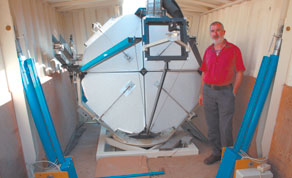
| Mokhtar Chmeissani standing next to the skeleton of the future Raman Light Detection And Ranging system |
The Qatar Energy and Environment Research Institute (QEERI) has recently completed a business plan for their agenda covering projects for the next three to five years, and are set to begin studies for their solar powered desalination pilot project.
Their work with solar power will also extend to other power applications, including cooling.
By the end of November, QEERI will sign a memorandum of understanding with CIEMAT, a Spanish energy research centre with the largest solar laboratory in the world, to make use of their experience and knowledge in renewable energy to bring the project forward.
“Our first task is to find the terrain to install this and to do the proper measurement, tuning and optimisation,” said Mokhtar Chmeissani, an instrumentation expert at QEERI, in an interview with Gulf Times.
Finding the right location is crucial for the project’s success, and Chmeissani is hesitant to rush into building a large solar plant right away, even though the funds and political will are available.
“The challenge is we should do it right, because any company will be happy to take money and spread their mirrors in the desert, but the question is: what will be the up-time of these things (when) operational? What will be the efficiency? If we do it wrong, people will start to lose faith in this, which is not correct,” he said.
The business plan calls for a 300 kilowatt concentrated solar power (CSP) parabolic mirror trough connected to a desalination system, with an integrated with molten-salt storage tank to capture thermal energy and supply power after sunset.
The desalination system will be a thermal-based system rather than reverse osmosis, which uses less power. The reasoning behind this particular choice is that the water supply for the power plants is “not stable” in terms of salt and other contaminant content, and reverse osmosis systems are likely to have significant down-time and require a great deal of maintenance to keep them functioning properly. As Qatar does not have a large fresh water reserve, the pilot project for solar powered desalination will need to be able to demonstrate that the supply of water can be steady and
dependable.
According to Chmeissani, QEERI would eventually like to use reverse osmosis for desalination in Qatar once water reserves can be guaranteed.
Chmeissani’s objective now is to determine the ideal location where air quality conditions are optimal for solar energy capture, as poor air-conditions can scatter the light meant to be caught by the CPS mirror troughs.
In next 12 months, solar and desalination equipment is expected to arrive in Qatar so that they can be assembled and operated individually to test them and familiarise operators with their systems, while studies and research on air quality can be conducted.
The institute has ordered a light detection and ranging device, commonly used in astrophysics to check the clearness of the sky to receive light from stars. The device fires a laser into the sky to see how much light is returned after bouncing off humidity, aerosol, and other atmospheric particles, in the sky up to 20Km from the surface of the earth.
“We’re trying to adjust technology that was built in places not like Qatar, Qatar has its own specific (requirements). We could maybe later transfer some of the know-how to Dubai or Bahrain, but even then when we go there we will also have to do the right measurements and tuning,” said Chmeissani.
Chmeissani and his team will also be testing new molten-salt power storage systems to optimize their performance, before scaling up their solar project to a four megawatt system. He says that his dream is to make all of Qatar Foundation powered by solar energy in the next five years.
He expects that the study and evaluation phase of the solar desalination project in Qatar will last three to five years, after which their recommendations will be handed over to the government for
consideration.
In parallel to this project, Chmeissani says QEERI will try to determine if and where wind power can be generated in Qatar, conducting a study of wind conditions around the country both onshore and offshore.
He is wary of pressure put on QEERI to rush the project, especially as other countries in the region announce plans for solar plants, as he believes that Qatar’s approach should be systematic and methodical to take advantage of the opportunity.
Chmeissani said that they are keen to avoid mistakes like the ones made in the Shams 1 project (Dubai, UAE), where plans to build a 100 megawatt plant were brought to a halt for one year due to incorrect estimates of the Direct Normal Irradianace (DNI) in the location that was chosen, which would have resulted in an efficiency loss
of 12.5%.