


 |
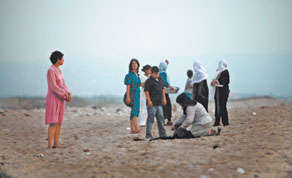
| Crayons of Askalan (Laila Hotait Salas |
Leading the five-member Narrative Film Competition Jury will be award-winning Syrian director Mohammed Malas, a filmmaking auteur widely recognised across the Arab World for his critical and socially engaging cinema.
Featuring eight world premieres, the Competition, in its second year, has been expanded and split into two juried segments of narrative and documentary films, with a set of new awards up for grabs including: Best Arab Narrative Feature; Best Arab Narrative Director; Best Narrative Performance Award; Best Arab Documentary Feature; and Best Arab Documentary Director.
The Festival will also feature two audience awards; for Best Narrative Film and Best Documentary with cash prizes of $100,000 each.
Malas received widespread international acclaim for his narrative and documentary films and has won a number of awards at film festivals around the world.
Among his most important films are Dreams of the City (1983) and The Night (1992) based on auto-biographical motifs, as well as The Dream (1981), a documentary that was shot in the Palestinian refugee camps of Sabra and Chatila in Beirut shortly before the massacres of 1982.
Malas stated that the Arab Film Competition is an important tool for supporting and promoting Arab films in this part of the world and providing an important recognition to emerging and established filmmakers.
“The Competition places select regional films up on an international platform, opening up various doors for films to gain exposure and distribution opportunities outside of the Arab World, which remains a fundamental issue within the regional industry,” he explained.
DTFF organiser Doha Film Institute executive director Amanda Palmer, commented: “Having someone of Mohammed Malas’ calibre lead our Narrative Jury, whose films have profoundly shaped the identity of realistic Arab Cinema, will bring the level of insight, experience and understanding needed to discover and illuminates storytellers from this region.”
She pointed out that in the third year of DTFF, DFI chose to expand the Competition, mainly because of the strength of this year’s submissions.
“It’s also exciting to see not only an increase of submissions generally, but more representation of films from female directors, as well as an increase in films from all over North Africa.”
The 2011 Arab Film Competition will feature a diverse and wide ranging line-up, including seven narrative films and seven documentaries, which centre around childhood and love, the turbulence of revolution, the inner world of Arab life and films which reveal the true nature of the lives of contemporary Arab women.
All films at the Festival will be subtitled in both Arabic and English, aiming to provide full cinematic access for audiences.
DFI’s chief Arab programmer Hania Mroue observed that the entries in the Arab Film Competition capture the lives, loves and modern day realities faced by everyday people in the region.
“They reflect the dreams, imagination, ideas and aspirations of the Arab world, both defined geographically and as people scattered around the globe.”
Led by Amanda Palmer, the DFI Programming Team also comprises Head of International Programming, Ludmila Cvikova, and resident filmmaker and programmer Chadi Zeneddine. The Programming Team also receives advisory support from various cultural partners and consultants.
The titles competing in the Arab Film Competition are:
Narrative - A Man of Honor (Jean-Claude Codsi), Red Heart (Halkawt Mustafa), How Big Is Your Love (Fatma Zohra Zamoum), El Shooq / Lust (Khaled El Hagar), Smuggler’s Song (Rabah Ameur-Zaimeche), Normal (Merzak Allouache), Omar Killed Me (Roschdy Zem).
Documentary - Rouge Parole (Elyes Baccar), The Three Disappearances of Soad Hosni (Rania Stephan), Yearning (Lina Alabed), Crayons of Askalan (Laila Hotait Salas), The Virgin, The Copts and Me (Namir Abdel Messeeh), Boxing With Her (Latifa Robbana Doghri), On the Road to Downtown (Sherif El Bendary).