Carnegie Mellon Qatar students Asma Hamid, a junior information systems major, and Afnan Fahim, a sophomore computer science major, have participated in this year’s Innovative Student Technology ExPerience (iSTEP) internship programme, joining Carnegie Mellon colleagues from the Pittsburgh campus.

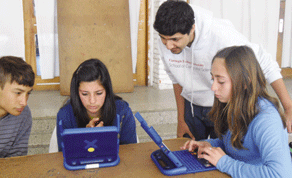
Fahim is seen testing the FBT kit with three students
iSTEP is an annual programme organised by the TechBridgeWorld research group at Carnegie Mellon University. The programme provides students with the opportunity to apply skills learned in the classroom to real world challenges in developing communities.
In recent years, iSTEP interns have worked on projects in Tanzania and Bangladesh and this year, the participants worked to improve English literacy skills in Montevideo, Uruguay.
For the first time, iSTEP is working with a government agency - the Administración Nacional de Educación Pública (National Administration of Public Education, ANEP), which is responsible for the development, management and administration of Uruguay’s public education system.
ANEP was pleased to work with iSTEP since the focus of the internship programme was to customise technology solutions to the community’s needs.
To identify these needs, the iSTEP team conducted several focus groups and interviews with administrators, teachers and students at Liceo 39, a local public high school, as well as student-teachers affiliated with ANEP.
Through the partnerships, the iSTEP team worked on three technology projects for improving literacy, which have the potential to influence educational programmes in Uruguay.
These projects were: One-laptop-per-child/computer tool (OCT), a Facebook tool (FBT), and a content authoring tool (CAT).
The OCT and FBT projects focused on creating engaging applications for students to practise their English literacy skills on the XO laptop - low cost laptops designed for educational purposes for kids in developing communities as a part of one laptop per child campaign - and through Facebook, respectively.
The CAT project allows teachers to customise literacy content on the OCT and FBT as well as track student progress.
The goals of the tools are to encourage students to practise their English literacy skills during their free time and to make it easier for teachers to distribute practice material.
These projects are near and dear to Silvia Pessoa (PhD), a CMU-Q professor, who is from Uruguay and graduated from Liceo 39, as well as an adviser for the 2011 iSTEP internship.
Speaking about the project, he said: “I am impressed by the team’s commitment to improving education through technology. The team has gathered great knowledge of what technology solutions would work best to make a positive contribution on English teaching in high schools in Uruguay.”
Fahim, based in Montevideo, was the technical lead of the FBT project and Hamid was the technical floater based in Doha, providing support across all three projects.
In describing iSTEP, Hamid said: “iSTEP was the best internship I have ever had. I have always been interested in research and the technology research experience iSTEP provided us with is priceless. Carnegie Mellon Qatar gave me a strong foundation to pursue a career in research in the future and the iSTEP helped me get a feel of what it would be like. It’s great.”
Fahim, who was pleased with language not being a barrier said: “My time in Uruguay proved to be an excellent experience, professionally and more importantly, culturally. The internship provided me with a great experience in understanding how material learned in the classroom can be directly applied to improve literacy in any other part of the world, where people didn’t even speak the same language as I did.”