The world’s first sustainable downtown regeneration project, Msheireb, aims to achieve one of the highest concentrations of Leadership in Energy and Environmental Design (LEED) certified buildings in the world.

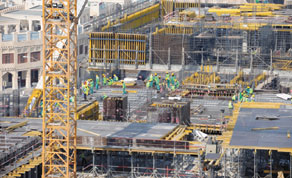
A partially completed building of the Msheireb Project in Doha
More than 100 buildings within the signature project in downtown Doha, which uses the original Qatari architectural language, will aim for an average LEED Gold rating, with several buildings targeting LEED Platinum.
Msheireb Properties (formerly Dohaland), the promoter of the world’s first sustainable downtown regeneration project, yesterday announced the appointment of Interface Engineering and Green Building Services as site-wide LEED consultant.
LEED is the internationally recognised building certification system developed by the US Green Building Council.
The Interface Global and Green Building Services team was selected from a field of highly qualified applicants for the breadth of its expertise and its commitment to sustainable practices.
Collectively the team has certified 352 LEED buildings of all building types around the world with another 275 LEED registered projects under development.
The master plan of the entire 31 hectare (76 acres) mixed-use site will be certified as a sustainable community.
Msheireb Properties CEO Issa M al-Mohannadi has said that sustainable development is a long-term investment in the nation’s future and reflects Qatar’s Vision 2030.
“This appointment will ensure our development meets the highest environmental design standards. Sustainable buildings, such as those that qualify for LEED certification, consume fewer resources, generate less waste, cost less to operate and provide healthier living and working environments for everyone -- both indoors and out. The regeneration of downtown Doha through the Msheireb project will benefit the environment and all of its citizens for years to come.”
The Msheireb project will transform a 31-hectare site at the centre of Qatar’s capital city, recreating a way of living that is rooted in Qatari culture, attracting residents back to the city centre.
The mixed-use development will comprise commercial and residential properties as well as retail, cultural and entertainment areas.
Interface Global and Green Building Services has been appointed to develop a site-wide framework and to implement individual building strategies with architects for all buildings to achieve LEED certification.
The team aims to have the entire Msheireb project certified as a sustainable neighbourhood.
Interface Global and Green Building Services will act as the commissioning authority to achieve the Fundamental and Enhanced Commissioning LEED requirements laid down by the US Green Building Council for all buildings and district cooling plants.
The Msheireb project master plan involves a series of sustainable design objectives, naturally managing climate issues without an over reliance on air conditioning.
This is done through the use of shading, split and thicker walls, and an emphasis on a sea-facing, north-south orientation.
The site design uses the prevailing wind and the slope of the land to cool buildings and streets, and colonnades to shade walkways.
Water efficient systems are being installed to reduce demand for fresh water, as well as a central cooling system to use and re-use groundwater.
The project also seeks to promote sustainable waste management and to implement a procurement policy that sources sustainable regional products and materials.