


 |
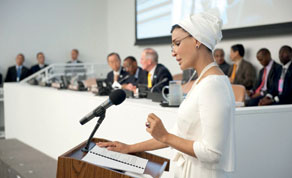
| HH Sheikha Moza bint Nasser speaking at a UN event |
Al Fakhoora’s flagship initiative is its unique scholarship programme which not only provides students with financial aid to complete their undergraduate education, but also provides economic sustainability to the families of the students.
Through a partnership with the UNDP’s Economic Empowerment Programme (DEEP), the scholars’ families are supported through economic empowerment initiatives to create and maintain economic sustainability, and thus injecting a chain reaction of economic revival in the community.
Other supporting interventions are offered to students such as career guidance, civic engagement and personal and professional development opportunities.
Annually, 100 scholarships are awarded to students in Gaza and 85% of these students received outstanding levels of academic achievement.
In its bid to contribute effectively to the education infrastructure and calibre of education in Gaza, Al Fakhoora has invested in reconstructing a number of damaged and destroyed university labs, libraries and facilities.
In order to ensure that the students enrol in disciplines sought after by the local job market, a labour market survey is being conducted to ensure employability for the students. Similarly, symposiums and workshops are designed and conducted specifically to cater for the needs of students in Gaza and fine tune their soft skills, language proficiency and leadership prowess.
 |
| HH Sheikha Moza bint Nasser addressing a Unesco event |
Al Fakhoora points out that though access to education is a basic human right, recognised by Article 26 of the UN’s Universal Declaration of Human Rights, today, school children and university students in Gaza and the West Bank are not able to fully exercise their right to an education.
During Operation Cast Lead, schools were bombed and destroyed. Many of those schools remain damaged or destroyed. And the current blockade deprives students and teachers of some of the basic necessities that no school can do without. It is an emotionally challenging environment in which to learn.
Fakhoora has been on the ground restoring students’ hope and dignity by repairing, rebuilding and refurbishing lab, libraries and learning facilities. The first phase of Fakhoora reconstruction effort has focused on the Islamic University’s two roofs and floors that were destroyed along with 74 labs, and engineering and IT buildings.
The School of Medicine will also be reconstructed acquiring an additional floor to its structure. In addition, Fakhoora will provide laboratory equipment for nursing, medical technology laboratory, biology laboratory, chemistry laboratory and optics laboratory.
As of March 2011, the preparation phase of construction work has been fulfilled, while the preparation phase for ordering furniture has almost reached completion. About 50% of the preparation phase for equipment has also been successfully completed.