


 |
|
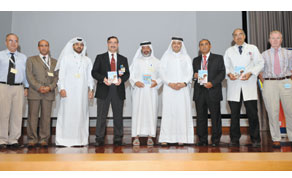
Dr Mohamed al-Thani with Dr Alam and others during the launch of the heat stress guidelines yesterday |
The Supreme Council of Health (SCH) yesterday launched a national Heat Stress Guidelines and Recommendations to be followed by all companies, especially those in the construction sector in the country.
The document prepared in co-operation with Readymix Qatar and available in English and Arabic, discusses in details what constitute heat stress, its risk factors, the importance of drinking water and of providing access to shade for outdoors workers.
It also explains heat index, its use to an employer and steps to take to prevent heat stress.
Other issues in the new guidelines are workers acclimatisation to the harsh climate in Qatar, determining dehydration through the urine colour, health effects, signs, symptoms and first aid in case of heat stress or exhaustion.
The heat stress guidelines, which are a result of a Heat Stress Prevention and Management workshop held in July 2009, will be translated into Hindi, Urdu, Malayalam and Bengali next year.
Heat stress disorders span a spectrum from minor heat illness to heat exhaustion and heat stroke, which could be a medical emergency because it can be lethal.
“These guidelines are valuable as early recognition and management of heat stress can prevent premature death and the best approach to its management is prevention, which is simple and effective if done properly,” SCH Public Health director Dr Mohamed bin Hamad al-Thani said.
The ministry of labour under law number 14 of 2004, decision number 16 of 2007 had said that all workers who are working in the open areas under the sun during the summer (from June 15 to August 30) should stop working between 11:30am and 3pm.
Dr Mohamed al-Thani lauded the government’s initiative to protect the outdoor workers saying: “This is one good intervention to protect workers from heat illnesses. However, this may not be enough. We feel there is a need of national guidelines on heat stress prevention and management so that employers and supervisors can readily access and use it to protect workers.”
Also, all the speakers at a panel discussion, comprising SCH Occupational Health section acting head and consultant Dr Wasif Alam, Hamad Medical Corporation’s Emergency Medicine consultant Dr Khalid Muayad and representatives of the ministry of labour, RasGas and Qatar Petroleum, reiterated the need for companies to comply with the new guidelines and recommendations coupled with the government’s directives on work hours reduction for outdoor workers during the summer months.