


 |
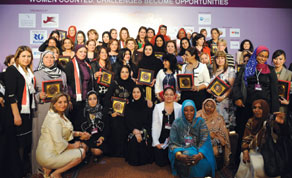
| Some of the women delegates at the second QIBWF pose in a group photo |
The second Qatar International Business Women Forum: “Women Counted: Challenges Become Opportunities” concluded yesterday with delegates calling for a closer affinity between women’s organisations in the Arab region for collective benefits and to gain more recognition.
The forum, held under the auspices of HH Sheikha Mozah bint Nasser and organised by the Qatari Business Women Association (QBWA) in collaboration with the Interactive Business Network, was attended by women’s organisations such as the Middle East and North Africa (Mena) Businesswomen’s Network, businessmen and women from around the world, business leaders, financiers, investors, entrepreneurs and decision makers as well as small and medium business owners.
Since its establishment, QBWA has played an important role in reinforcing the participation of women in the Qatari economy and the association has also contributed to the establishment of the Mena Businesswomen’s Network as a pioneering body in the field.
 |
| Aisha Alfardan and other panellists at the concluding session |
“In the beginning we did not have it easy, but through the help of HH Sheikha Mozah, who provided a strong push for the Qatari women and helped us break barriers while also maintaining the Qatari identity, culture and customs, we were able to discover feet,” she said.
Alfardan mentioned that the QBWA caters to the needs of different categories of women, both new entrants and old accolades in business field by organising workshops and interactive sessions for them.
Apart from discussing the situation of businesswomen’s associations in the Arab countries and the world at large, the session, moderated by Berlin-based journalist and TV moderator Astrid Frohloff, also touched on role of women’s associations and how their relations can be activated.
Other issues discussed were activating the role of women in the growth and political stability; strengthening links between women’s organisations in different countries; and exchange of expertise and experience in different societies.
Panellists at the session, in addition to Alfardan, were Sudan Chamber of Commerce board member Samia Shabou, UK-based The Sanne Philanthropic Foundation director Gillian Arthur, Hanan Saab general manager of Pharmamed – Beirut, Lebanon and the US-based Vital Voices Mena Businesswomen’s Network Mary MacPherson.
Other issues highlighted by delegates were: challenges women face in family business with focus on - building up the right governance structure in family businesses; the borderline between ownership and management; networking limitations for businesswomen; passing on leadership merits from one generation to another.
Organisational capabilities and strategies in small- and medium-sized enterprises were also discussed at another session.