


 |
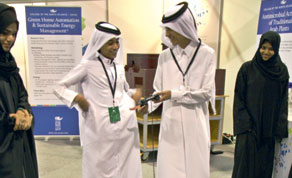
| Students try out a CNA-Q robot |
Two of the projects were from the CNA-Q’s Instrumentation Programme: one a virtual instrumentation project called “NetLabs” and another on an automated industrial sorting project.
A data collection robot for the “Save the Hawksbill Turtles Project” was also on hand, as well as a QNRF award winning green home automation experiment.
A final project on the “Antimicrobial Properties of Traditional Arab Plants” rounded out the
contribution.
Paul Dawson, who leads the “NetLabs” project at CNA-Q, said: “We were really quite surprised with the students’ eagerness for more information and their theoretical knowledge. Now what they seem to want is to come and visit our labs to see more of the hands-on action of
research.”
Six CNA-Q faculty members also acted as judges for the competition. They were Dr Roman Pedzenski, James Keith, Susana Paloma, Andrea Comeau, Dr Ziad Said and Marcin Wawrzyniak.
Similar to the researchers’ reactions, the judges were equally impressed with the quality of student projects and their desire to discuss their research.
Comeau, a communications specialist at CNA-Q, also noted the degree of fluency students possessed in talking about their research.
He said he was very impressed with the range of projects as well as the solid English language ability both in oral and written presentations.
“Of the six projects I judged, two of the junior projects were particularly entertaining and interesting due to the enthusiasm of the student presenters. The students I spoke with were proud of themselves, engaging, entertaining and articulate,” he added.
Dr Michael Long, Chair of Applied Research and Innovation at CNA-Q, was also impressed with the SEC’s efforts. “One cannot wait until a student enters university to introduce them to the procedures and rigors of sound research and critical inquiry. This must be fostered from the earliest possible age, so the SEC’s initiative is to be commended indeed.”