


 |
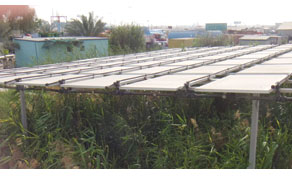
| The ‘Rainforest Concept’ – reed bed with solar panels on top |
The Unesco Doha Office is to get a demonstration unit of TerraSave, an eco-friendly system which converts waste water, including human waste, into water for a variety of purposes.
TerraSave, developed by the Dubai-based Emirati-Austrian construction company Waagner Biro Gulf, had won Qatar Today’s Green Innovation award in 2009 for wastewater treatment and sludge dewatering at the Al Khor Community.
“At the heart of TerraSave is the time-proven reed bed sewage treatment system,” Waagner Biro Gulf’s Middle East director for water, energy and environment technologies, Peter Neuschaefer, told Gulf Times.
The TerraSave concept combines different technologies such as photovoltaic (PV) and concentrated solar power (CSP), the cooling of the PV modules using treated wastewater, harvesting the reeds as biomass, and the storage of the solar power into batteries, thus getting CO2 reduction results.
Unesco’s ecological science adviser in the Arab region, Dr Benno Boer, pointed out that Waagner Biro Gulf was famous for having constructed the floating bridge across Dubai Creek in 2007.
 |
| Peter Neuschaefer |
“The TerraSave system to be installed in Unesco Doha Office, would have PV modules on top of the reed beds to reduce the solar radiation that reaches the plants, in addition to generating power,” Dr Boer explained.
The power so generated is used to pump up the treated water to clean the dust off the solar panels and cool them before flowing back to the reed bed from where it is used for various needs. Neuschaefer describes this as ‘the rainforest concept.’
The Unesco Doha Office has about 25 staff members. Visitor numbers reach up to 50 or 60 on some days. During peak summer – July and August – there would be only three or four people in the office.
“So Waagner Biro has calculated that we need a reed bed of 1m height, 1m depth and 5m length, which is to be made above ground, like a concrete box,” Dr Boer said.
Citing his visits to Waagner Biro Gulf’s sites in Dubai, the Unesco official said the company is treating the greywater and blackwater at its labour camp and using the recycled water for irrigation.
“They even have the capacity to use this water for the production of vegetables. Around their headquarters offices they have a fish pond with lush aquatic vegetation around it and fish swimming in the water,” he said.
Dr Benno was of the view that TerraSave could be taken up in Qatar on a larger scale and put the recycled water to a host of productive purposes.
“The TerraSave concept should be taken up a commercial basis. The malls in Qatar could do it. Restaurants, universities, and schools could do it as well,” he suggested.
Neuschaefer said Waagner Biro Gulf hopes to start the installation work at Unesco Doha Office compound in the next two to three months.
“This will be a real demonstration project for the people here in the region to come and see,” he added.