


 |
|
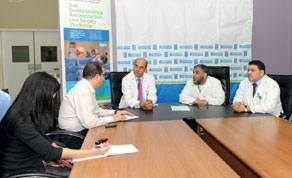
Dr al-Naimi, Dr Shamsodini and Dr al-Zubaidi speaking to mediapersons yesterday |
People suffering from erectile dysfunction or facing difficulty to pass urine should seek early medical intervention and feel free to discuss their problems with physicians to avoid “serious and irreversible complications”, urology experts have suggested.
Speaking yesterday at a press conference organised to announce the “Second Genito-Urethral Reconstruction Live Surgery workshop” to be held at the Hamad Medical Corporation’s Hajar Auditorium from April 7-9, urology section head Dr Abdullah Rashed al-Naimi said that the main purpose of the workshop was to showcase the department’s expertise in managing the major genito-urethral problems affecting men in the country.
“Our aims are to show that HMC is capable of delivering the treatment and surgical procedure successfully as well as provide an opportunity for urology doctors and surgeons to exchange ideas and experiences while also maintaining contacts with international speakers that we are inviting for the workshop,” he explained.
“In our clinic, we give patients a very good privacy, given that the problem is of a private part of the body, and this has encouraged many more patients to show up for treatment,” he said.
The treatment and surgical procedure, according to him, has provided up to 94% patient satisfaction.
“The focus of the workshop will be on treating two major problems of extremely difficult urethral stricture and erectile dysfunction (impotency) in men through advanced technology such as prosthesis implant and urethro-plasti,” Dr al-Naimi said.
Four cases each of urethral stricture and penile implant will be done respectively during the second and third day of the workshop, while international experts will also see some complicated patients after the event.
According to him, erectile dysfunction can be treated with tablets or injections or vacuum devices and implant prosthesis in advanced cases while the other problem of urethral stricture is usually done through endoscopy with a very complicated one done by a process called urethro-plasti (urethra plastic surgery).
He said the services being offered at the department since about eight years ago, has become advanced and very popular among patients within and outside Qatar as in the past, cases of penile implant was not as much until last year when it rose to 35 from just five.
The urethro-plasti is also climbing above 20 cases per year, the figure is expected to double this year, he said.
“Because we are getting good reputation in our services, as well as providing easy access to service with our dedicated surgeons carrying out the procedure, all of these reasons are affecting the increase in number of cases and not that the disease is increase among the population,” Dr al-Naimi said.
He said that many patients also now preferred to have the treatment and surgery locally instead of travelling abroad as the level of acceptance was increasing.
Urology consultant Dr Ahmad Shamsodini explained that erectile dysfunction did not occur by itself but in association with other diseases like diabetes, hypertension, high cholesterol and obesity and because of the awareness of the disease and the increased aging population, more patients are coming with erectile dysfunction.
He said that 80-85% of patients will require treatments such as the tablets, injections or vaccum devices while the remaining up to 25% will need penile or prosthesis implant.
“There are two types of implant - malleable and inflatable implants, which are very advanced as they are covered or impregnated with antibiotics to prevent infections, which had led to complications in the past, as there used to be concerns regarding complications due to infection some 10 years ago,” he explained.
Urology specialist Dr Riadh al-Zubaidi urged patients to seek early medical intervention to prevent further complications as well as the devastating effects of the problem on the family.
“Those suffering from these problems are depressed causing instability in their family and at work,” he said.
About 150 participants, including international speakers from the UK, Italy-Europe, India and Serbia are expected at the workshop.