


 |
|
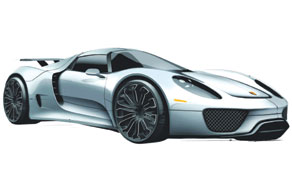
A sketch of the Porsche 918 Spyder super sports car |
The car is estimated to consume a mere three litres of fuel per 100km based on the New European Driving Cycle (NEDC).
Its V8 engine delivers more than 500hp, assisted by two electric motors with a total of at least 218hp.
The 918 Spyder is available for immediate order with a price tag of $897,550 in the GCC markets.
To ensure exclusivity, the two-seater is limited to 918 units.
Production of the 918 Spyder is scheduled to commence on September 18, 2013 at Porsche’s main plant in Stuttgart-Zuffenhausen. Delivery of the initial vehicles will commence in November 2013.
The design’s DNA is derived from the Carrera GT and Porsche 917 sports car as well as the RS Spyder and is very closely modelled on the 2010 concept car.
Unlike the concept car, however, the production version of the two-seater, based on a carbon fibre-reinforced plastic monocoque, features a manual roof system with removable roof panels that can be stowed in the front luggage compartment.
The mid-engine power unit is based on the racing engine of the successful Porsche RS Spyder, which provided impressive proof of its efficiency with its multiple victories in the Michelin Green X Challenge in the American Le Mans Series, the Le Mans Series and the 24 Hours of Le Mans.
Power transmission to the rear wheels is by means of a compact, seven gear Porsche-Doppelkupplungsgetriebe (PDK). The energy storage unit is a liquid-cooled lithium-ion battery that can be charged from a conventional domestic power socket, delivering a range in excess of 25km in the NEDC on purely electric power.
The charging time depends on the country-specific mains network, being approximately three hours in Germany, for example. A quick charging option is planned to reduce charging time yet further.
The 918 Spyder’s CO2 emission is just 70 g/km. It accelerates from a standing start to 100 km/h in a maximum of 3.2 seconds and has a top speed of more than 320 km/h. The top speed on purely electric power is 150 km/h.