By Ross Jackson
A panel of experts yesterday hailed the role of media in Middle Eastern revolutions, particularly its contribution in carrying ideas and sentiments across boundaries and refuting the untruths circulated by tyrannical governments.

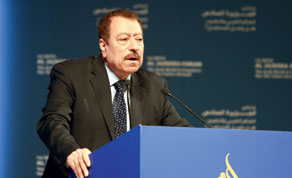
Abd al-Bari Atwan, Editor-in-Chief of al-Quds al-Arabi speaking at the Al Jazeera Forum
Speaking at the 6th Annual Al Jazeera Forum in Doha, Mark Lynch, professor of Middle East Studies at George Washington University, said that there was no distinction between the old mass media and new social media, “as news outlets such as Al Jazeera depend on media such as Facebook, YouTube and Twitter for their content and in fact uses the authors of that content as sources.”
“This dependence is more distinct when governments actively try to shut down the work of journalists as was the case in Egypt, when government forces attacked and arrested members of the press, and ordinary Egyptians took it upon themselves to provide the world with footage and photographs of the uprising.”
Mohamed Nanbhay, head of New Media at Al Jazeera, explained that his network had no correspondents in Tunisia at the time of the uprising and they relied on the footage of thousands of citizens.
Ayman Mohyeldin, Al Jazeera correspondent, pointed out the issues that the people suffered from such as corruption “are pan-Arab issues and due to the inter-connectivity of citizens online, knowledge of the outside world and different political environments is at their fingertips”.
He said: “This fact combined with modern media’s ability to share information quickly has resulted in the rapid pace of development of reform movements.”
Abd al-Bari Atwan, Editor-in-Chief of al-Quds al-Arabi, praised Al Jazeera in particular as having a pivotal role in the fall of former Egyptian president Hosni Mubarak, saying that the network was going “to kill more tyrants in the Arab World.”
Atwan also said that Al Jazeera and other progressive media outlets paved the way for the revolutions by “raising issues that were previously met by silence,” such as parliamentary and democratic reform, directly challenging autocratic regimes.
In another plenary session at the Al Jazeera Forum, panellists from a number of politically turbulent countries gave their views on the changing face of the region. Opposition leaders and activists from Tunisia, Egypt and Libya gave their views on the reasons for the revolutions, the conduct of the people involved.
Rachid Ghanouchi, founder of the Tunisian Renaissance Party, cited the fact that Mubarak’s wife left Egypt to give birth to his son as one example of how many dictators are isolated from their people.
Farag Saad Farag, a Libyan youth activist from Benghazi, explained that Gaddafi had created a state of “organised chaos,” with no constitution or official charter other than his Green Book.
Farag praised the Arab League’s stance in favour of the opposition, saying that the league was “starting to talk the language of the streets and the people.” He also said, however, that more support was needed.