By Bonnie James
The sand dunes of the Mesaieed area, which includes Qatar’s major tourist attraction Khor Al Udeid (Inland Sea), a globally unique set of land and seascapes, could be gone in about 1,000 years.
The main wind direction from the North North West towards the South South East (SSE) will pool the sand into the Inland Sea and beyond into the eastern province of Saudi Arabia.
“But we are talking about geological times, it could be 500, 1,000, 1,500 or maybes more years,” Unesco’s ecological science adviser in the Arab region, Dr Benno Boer, said.
The supply of sand in the Mesaieed area has been described as “limited to exhausted” by Jorg Beineke and Andreas Kagermeier in an article included in Sabkha Ecosystems - Volume III: Africa and Southern Europe, published by Springer in The Netherlands.
The origin of the dunes in southeastern Qatar is still uncertain, according to them. Most researchers believe that the siliciclastic sands of the Mesaieed dunefield are of external origin and were not generated on Qatar peninsula.
The mineralogy of the dune sands indicates to an origin on the Arabian mainland, which nowadays is separated from Qatar peninsula by the Gulf of Salwa.
It is speculated that during late glacial lowstands of the Arabian Gulf, combined with the enhanced Shamal winds of this time period, dunes were piled up in the eastern province of Saudi Arabia and moved onwards in SSE direction towards the Gulf of Salwa.
Sandbars (former transverse dunes today covered by coastal waters) which are detectable on satellite images of this area point to the fact that the dunes moved over the then dried out Gulf and reached the northwestern coast of Qatar.
As sea-level rose in the early Holocene, the dunes were cut off from the sediment source areas in the northwest and were eroded by under-saturated winds, thereby moving further to the SSE.
Due to an almost flat territory, the sands passed the Eocene limestone formations of central Qatar without major disturbance and reached the southeastern coast, where huge amounts of sand were spilled into the low-lying coastal areas and the sea.
“Since we study climate only really since 120 or 150 years, we don’t know how fast climate changes or how long could it take,” Dr Boer maintained.
If the climate changes on a regional scale and stronger warm winds come into Qatar from the Empty Quarter (the world’s largest sand sea, at more than 583,000sq km, it is spread across Saudi Arabia, Oman, Yemen, and the UAE) then the dunes might be pushed to the other direction.
“We see that sometimes, at least with the dune crests. However the current trend is so that the main wind direction is NNW to the SSE and dunes are travelling in this direction very, very slowly,” Dr Boer said.
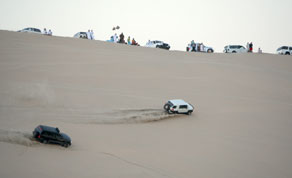
The recreational traffic in the area makes the dune crests a little bit more exposed to wind erosion. The large number of livestock which is immediately grazing off all the vegetation which can cover the sand, is also accelerating this.
“If you have eight percent of the soil covered by vegetation you have normally no excess wind erosion, but here in Qatar most of the area it is only zero to one percent,” he added.