


By Bonnie James/Deputy News Editor
Sabkhat or hyper saline coastal flats are part of Qatar’s natural heritage and people should be educated about them, Unesco’s ecological science adviser in the Arab region, Dr Benno Boer, has suggested.

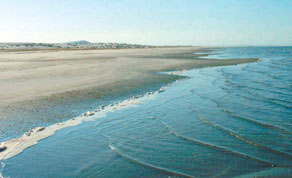
A stretch of coastal sabkha at the Khor Al Udeid area of Qatar
“Though they are inferior in comparison to other eco-systems, they should be studied and understood and they have a gigantic potential for the development of manmade eco-systems under seawater irrigation,” he explained.
There are 42 distinct areas of sabkha in Qatar, totalling 701sqkm, it has been pointed out in an article in the second volume of the three volume series, ‘Sabkha Ecosystems,’ prepared by a group of experts including Dr Boer.
The majority (66%) of these areas are small in size, each less than five sqkm, and about half of them in fact less than 1sqkm.
Medium size (5-15sqkm) sabkhat account for about 25% of the areas, and the rest, ranging from 15 to 35sqkm in size, can be classified as large. A large area of sabkha, in total about 95sqkm, is situated up to 6m below sea level.There are coastal and inland sabkhat. Many coastal sabkhat are subject to occasional inundation by the sea during high tide, whereas in contrast inland sabkhat receive their water supply from high ground water levels, precipitation or run-off from adjacent areas.
Coastal sabkhat are found predominantly on the eastern coast of Qatar, with the largest site located in the southeast, immediately south of Mesaieed.
Smaller areas of coastal sabkha also occur along the western coast, mainly south of Dukhan. Depending on the extent to which seawater affects the physical and chemical properties of the sabkha, it is possible to differentiate between internal coastal and external coastal sabkha.
Internal coastal sabkha is in direct contact with the sea, and is therefore regularly affected by tidal action. Shallow intertidal pools frequently develop, but they tend to dry out rapidly, leaving behind a distinct saline surface crust.
Good examples of internal coastal sabkhat are found at Al Khor, Al Dakhira and Feshak.
The influence of the sea is not as prominent with external coastal sabkhat as they are usually located behind sandy or rocky barriers.
Examples of external coastal sabkha can be observed at, or near, Al Khor, Al Dakhira, Mesaieed, Dukhan Umm Bab, Al Odeid and Al Zubarah.
Mesaieed is the largest coastal sabkha in Qatar, extending some 55km in length and between four and 14km in width. It has developed from a former lagoon that gradually became filled with Aeolian siliciclastic sands.
Apart from a saline crust, the sabkha at Mesaieed is characterised by high gypsum content in the sub-surface layers, the texture of which can be characterised as sandy calcareous loam or clay loam.
The high gypsum content probably contributes to the overall stability of the sabkha surface, allowing it to be easily driven over with a vehicle, except under wet conditions.
In the case of inland sabkhat in Qatar, the 78 patches account for an area about 205sqkm, the majority being very small, usually less than 1sqkm in size. Only a handful exceeds 5sqkm.
None of the inland sabkhat appears to be influenced by seawater, as they are located beyond land barriers parallel to the coastline. Examples include Dukhan, Souda Nathil and Kobath.