


By Fran Gillespie/Correspondent
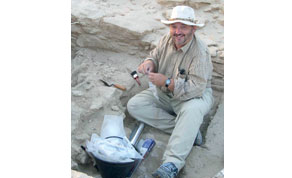
Dr Beech working on an archaeological site
Not so long ago – in geological terms that is – the lands bordering the western coast of what is now the Arabian Gulf were watered by a network of reed-fringed rivers, up to 40m in width, amid a lush, forested landscape.

It was an age not only of plants, but above all of mammals.
Bizarre-looking ancestors of modern elephants and giraffes wandered through the forests, browsing on the rich vegetation.
Not all were peaceful herbivores: giant sabre-toothed cats crouched amid the bushes and acacia-type trees, watching for their chance to spring out upon an unsuspecting antelope or a primitive three-toed horse.
Crocodiles lurked in the rivers, waiting for the animals coming to drink.
Dr Mark Beech, cultural landscapes manager in the Historic Environment Department at the Abu Dhabi Authority for Culture and Heritage, was in
Based in
But in recent years Dr Beech has been involved in a project recording the extraordinarily rich fossil remains of the Late Miocene period of 6-8mn years ago.
The area where finds are being made is known as the Baynunah Formation, stretching along an area roughly parallel to the present coast of the UAE.
Fossil remains range from the largest ever found anywhere in the Arabian peninsula – an elephant tusk measuring an impressive 2.5m in length – down to the tiny tooth of a cane rat, hardly bigger than a grain of rice.
The speaker was at pains to dispel any images the audience might have held of fossil-hunters casually strolling around the desert locating and digging up spectacular specimens.
Much of the work, he said, involved hours of patiently fine-sieving gravel and sand, looking for such small remains as teeth.
Remains of larger fossils are so fragile that they cannot be excavated in the normal way.
Instead, they are first covered in fine sand and wrapped in wet plaster bandages which harden to form a rigid case.
Only then can they be carefully lifted from the ground and conveyed to a laboratory to await years of research.
Intriguingly, three species of elephants roamed the landscape of the Miocene UAE.
One, Stegotetrabelodon syrticus, had four tusks adapted to forking out vegetation from the upper branches of trees.
“Rather like chopsticks,” commented Dr Beech.
Another species had tusks apparently more adapted to browsing on lower vegetation.
In this way each species had its own niche feeding zone, and avoided competition.
Archaeologists and paleontologists rely for many of the discoveries on the sharp eyes of bedouin rangers, who are trained on what to look for and instructed to report anything they see without disturbing it.
A system of financial rewards for exceptional finds helps to fuel the rangers’ enthusiasm!
A recent very rare discovery was the pelvis of an ostrich, ancestor of the Arabian ostrich which became extinct in the last century when hunters had access to vehicles and firearms.
“We never find complete skeletons,” Dr Beech said, “because the dead animals were usually washed down in rivers and the bones were scattered.
“Or carnivores gnawing the remains contributed to the disturbance. We use paleomagnetic dating to try and determine the age of the fossils.
“Over many millions of years the field of polarity changes. When samples of rock from the area surrounding the fossils are cut the position of magnetic north is recorded, and this assists in dating.”
Research into the fossil terrain of the UAE began some 50 years ago, said Dr Beech, and new discoveries constantly change the image of that ancient landscape.
Until very recently the accepted picture was of a savannah-type landscape watered by rivers, but discoveries of large networks of tree roots and branches, and the teeth of squirrels which inhabited the trees, make it clear that there was more forest than was originally believed.
As in the case in Qatar, archaeologists and researchers into the past of the UAE are having to compete with the demands of developers. However, strenuous efforts are being made to preserve the most vulnerable of the prehistoric landscapes.
Sites that are under threat are fenced off against bulldozing and damage by vehicles, said Dr Beech.
These include prehistoric animal tracks, one of which is the longest set of elephant tracks in the world.
“The Baynunah Formation is now on the Tentative List for nomination as a World Heritage Site,” he said, “and this makes developers more cautious.”
Dr Beech’s visit to Qatar was sponsored by the Rayyan Mineral Water Company.