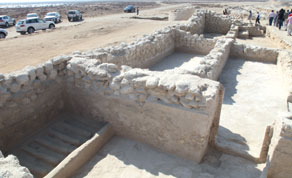
A key feature of the ongoing archaeological excavations at Qatar’s historic sites, including Al Zubarah and Furayhah, are the numerous examples of date presses (madebes), used to produce date-syrup.

A date-press (bottom left) is seen at the Zubarah excavation site. PICTURE: Bonnie James
“This syrup (dabs) was a basic staple of the traditional Gulf diet,” archaeologists Dr Tobias Richter, Paul Wordsworth and Alan Walmsley from University of Copenhagen’s department of Cross-Cultural and Regional Studies have said in a paper.
The trio are part of a team that has undertaken Qatar Islamic Archaeology and Heritage (QIAH) project, an initiative of Qatar Museums Authority.
“Given its highly nutritious value, the date-syrup was probably also used as an easily storable high-energy food supply for the trading and pearling fleet, and it may have even been an export item,” it is explained in the paper to be presented at the upcoming 2011 Seminar of Arabian Studies in London.
The channels of the date presses were first covered in palm tree leaves and sacks of dates were stacked up on top. Their weight squeezed out the date juice which was collected in the channels and diverted into an underground storage jar.