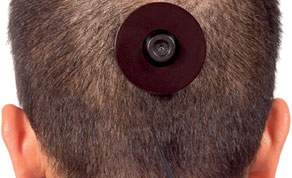
A health-scare has prompted the New York-based Iraqi-born artist Wafaa Bilal, the brain behind Qatar’s Mathaf: Arab Museum of Modern Art’s new media installation the ‘3rd I,’ to take off the camera fixed to the back of his head and tie it to the back of his neck.

A file picture of the camera fixed to the back of Bilal’s head
An assistant professor in the photography and imaging department of New York University (NYU)’s Tisch School of the Arts, Bilal underwent surgery on February 4 for removing one of the three anchoring posts that held the camera in place.
The posts are connected to a titanium base fixed between his skin and skull, reportedly by a body-modification artist at a Los Angeles tattoo parlour in November last year before switching on the camera on December 15 in Doha.
The ‘3rd I’ is one of 23 contemporary works commissioned for an exhibition entitled ‘Told/Untold/Retold’, which opened on December 30 at the Qatar Museums Authority’s new exhibition hall on the Museum of Islamic Art grounds, as part of Mathaf’s inauguration.
The circular digital camera, which could be described as Bilal’s ‘3rd I’ takes a still photo every minute and shares it with the world through a website (www.3rdi.me) and the installation.
The Chronicle of Higher Education reported that one of the mounting posts of the camera was rejected by the artist’s body, despite treatment with antibiotics and steroids.
“I am taking all the necessary precautions to prevent any infection,” he had told Gulf Times in Doha on December 15 at a preview of his year-long project.
The other two posts are intact and once the wound heals Bilal hopes to figure out a different setup and remount a lighter camera.
Asked why not simply wear the camera, as he is doing now, rather than implant it again, the artist reportedly said: “It is a performance. With the performance comes endurance. But also it is a commitment. And I did not feel that strapping something around my neck would be the same way I am committed to the project as mounting it to the top of my head.”
“It still hurts,” he was quoted as saying by BBC World Service in a report dated December 31.
“I still have to treat it (the area around the implanted base) regularly with hot towels and salt water,” he explained.
Yesterday was day 64 of the project. “Each picture is stamped with time, date and location, and you can track me every minute through a GPS map on the website,” Bilal had told Gulf Times.
Everyday life had become a bit more complicated for him after fixing the camera. He needs to wear a transparent shower-cap.
Going through airport security, on his first flight (after fixing the camera) proved a long process, involving various scans and tests.
Bilal’s girlfriend has been very supportive of his artistic experiment and has not imposed any lens cap curfew for any moment of their lives, he told the BBC.
Gulf Times had asked him what would happen to his private moments. “My private moments will become public moments,” was his answer.
Bilal, who is teaching three courses this semester, has to keep the camera capped while he is on campus, on account of privacy concerns of others.
The project, according to the artist, “arises from a need to objectively capture my past as it slips behind me from a non-confrontational point of view.”
He says he is left with only ephemeral memories of his journey from Iraq to Saudi Arabia, Kuwait and the US, and wishes he could have better recorded his experiences.
Bilal fled Iraq in 1991 when his city Najaf was under bombardment. He spent two years in a refugee camp, before moving to the US, where he was granted political asylum.
Most of his family stayed behind, and in 2004 his brother Haji was killed by a missile at a checkpoint. His father - heart-broken and devastated - refused to eat or drink, and died soon after.