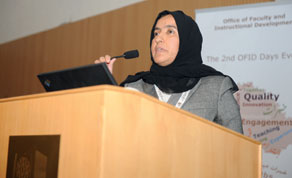
Qatar University’s Office of Faculty and Instructional Development (OFID) days’ event concluded yesterday following an intensive programme of faculty dialogue and interaction.

Dr Sheikha Jabor al-Thani speaks at the event
Organised for the second year by the OFID, the two-day event was aimed at bringing QU faculty together to share experiences in advancing a high-quality teaching-learning environment.
This year’s theme was “Engagement for Excellence: Sharing QU Commitment and Experiences.”
The opening ceremony was attended by QU leaders, deans, heads of department, faculty and staff. OFID director Dalal Moukarzel in her introductory remarks, said: “In the discussions, we will share some of our best experiences that show that QU is moving forward towards strengthened teaching quality and better outcomes for our students year after year.”
In her opening address, QU vice president and chief academic officer Dr Sheikha Jabor al-Thani gave a presentation on “Institutional Effectiveness,” stating that effectiveness is a lived activity, and must be integrated fully into the administrative and academic culture of the organisation. “It must also be tied to the outcomes,” she said, adding, “it points to the question of how we are enhancing what we are doing, and on what basis.”
Dr al-Thani also stressed “quality” as the buzzword for QU’s programmes and research activities. “This is integral to our mission and the objectives of our strategic plan,” she said.
The chief academic officer further discussed the importance of faculty participation in professional development activities and engagement in research.
“The goal should not just be to advance careers, but also to participate in institutional governance, advance student competency, and to be involved in contributing to solutions to the challenges within the Qatari community at large,” Dr al-Thani said.
QU College deans and programme directors also shared their experience of leading the process towards international accreditation for their respective college and programmes, and guiding projects in research, graduate studies, and community relations.
Over 250 faculty participated in the panel session on the first day, and more than 480 in parallel sessions in the following day’s programme.
Also participating were faculty counterparts from the University of Calgary and the American University of Beirut, as well as QU partner Shafallah Center for Children with Special Needs.
The second day’s programme offered a wide range of topics such as increasing student motivation, supporting special needs’ students, interdisciplinary project building, technology enhancement in class and using iPod and iTunes technology to complement teaching.