An expert with the Unesco Office in Doha has expressed hope that Qatar would make progress in its ambitious and globally unique Qur’anic Botanic Garden project.

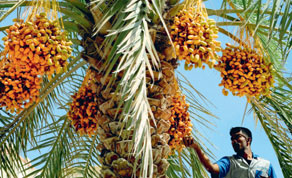
The Holy Qur’an mentions a number of plants, including date palms, figs, grapes, olives and pomegranates
A proposal to set up a botanical garden based on the scientific and aesthetic concepts contained in the Holy Qur’an was approved by the Unesco headquarters in 2006.
 The expert team that authored the proposal comprised architect Guido Licciardi, vegetation ecologists Dr Shaukhat Ali Chaudhary and Dr Benno Boer, horticulturists Dr Rashid Idriss, Islamic expert and botanist Dr Mohamed al-Farooqi, and landscape architect Grant Donald.
In his books The Plants of the Qur’an and Medicinal Plants in the Tradition of Prophet Muhammad, Farooqi cites a number of plants mentioned in the Holy Qur’an including date palms, figs, grapes, olives and pomegranates.
In April 2007, Qatar Foundation (QF), Unesco and Maersk Oil Qatar entered into a partnership to set up a Qur’anic Botanic Garden at Al  Shahaniya.
 In September 2008 QF chairperson HH Sheikha Moza bint Nasser officially inaugurated the project at Education City by planting a Sidra sapling.
The project features plants mentioned in the Holy Qur’an and Hadith (Sayings) of the Prophet.
“I hope to see some progress in this regard shortly,” said Boer, who is also Unesco’s ecological science adviser in the Arab region.
The garden features will be based on the more than 150 verses that mention the Gardens of Paradise (Jannat al-Firdaws) in the Holy Qur’an.
Over the centuries, these verses have inspired a number of Islamic gardens, embodying a physical representation of heaven on earth, and have influenced some of the most beautiful landscape architectures all over the world.
The project would help achieve important objectives in the fields of environmental conservation, scientific research, education and recreation.
A living display of plants mentioned in the Holy Qur’an, arranged as a traditional quadripartite garden, will be useful to carry out training programmes in the field of environmental conservation, as well as to spread knowledge of the Holy Book.
The Qur’an Botanic Garden will also provide an opportunity for scientific research on the link between biodiversity and ecosystems.
Spreading over 24 hectares on completion, the project will include about 350 species of local flora, apart from 51 plants mentioned in the Qur’an and Hadith - from mustard, saffron and henna to pumpkin and pomegranate.
A specialised heritage library, a special corner for traditional uses, and a newsletter for students and researchers are also planned.