


By Bonnie James/Deputy News Editor
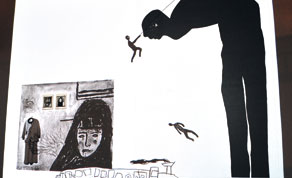
Sadik Kwaish Alfraji’s ‘The House that My Father Built’
Twenty-three stories of journeys through time and place come to life at ‘Told/Untold/Retold,’ one of the three inaugural exhibitions of Mathaf: Arab Museum of Modern Art.

‘Told/Untold/Retold,’ opened to the public on December 30 at Al-Riwaq Art Space, the exhibition hall at the
The exhibition brings together 23 artists with 23 commissioned works that mark a significant departure, a new way of looking at both art and the world.
Curators Sam Bardaouil and Till Fellrath describe ‘Told/Untold/Retold’ as the first and largest exhibition of contemporary art on this scale within a museum context in the history of the Arab world.
In a world where everything is in motion, artists are not confined within rigid cultural identities based on the traditional geography.
The exhibition invites viewers to look at artists, not as national representatives but as ‘transmodern’ artists in consistent metamorphosis.
Painting, sculpture, photography, video, multimedia installations and interactive digital art are featured in ‘Told/Untold/Retold’ which seeks simply to let the artists speak, free of stereotypes or contrived connections.
The participating artists are Adel Abidin, Sadik Kwaish al-fraji, Buthayna Ali, Ahmed al-soudani, Ghada Amer, Kader Attia, Lara Baladi, Wafaa Bilal, Abdelkader Benchamma, Mounir Fatmi, Lamia Joreige, Amal Kenawy, Jeffar Khaldi, Hassan Khan, Youssef Nabil, Walid Raad, Khalil Rabah, Younes Rahmoun, Steve Sabella, Marwan Sahmarani, Zineb Sedira, Khaled Takreti, and Akram Zaatari.
Some stories are ‘Told,’ evoking autobiographical accounts and nostalgia for the things that were. Other stories are ‘untold,’ anticipating an imagined future that speaks of things that could be.
And there are those that are ‘Retold,’ proposing an alternative narrative to the things that are. Central to each story is the use of time as a concrete compositional element and the reflection on the act of journeying, a condition that has come to describe the rampant fluidity of today’s society.
In discussing the curatorial themes of the exhibition, Bardaouil and Fellrath said: “Today’s artists are in constant transmigration across a diversity of cities and locations, yet never escaping redundant geographical labels through which their work is misconstrued. They are in perpetual metamorphosis, in a state of ‘in-betweenness.’
These journeys occur not only in place, but also in time.
“When you move and leave things behind, you remember, recollect and reconstruct, but you also reorient and redirect yourself. These are all acts into which time is intricately weaved.
“This explains why time is often a significant formalistic component within contemporary artistic practice. In that sense, ‘Told/Untold/Retold’ is a subversive confrontation, celebrating a wilful act of uprooting that is reflective of the transient condition of our world.”
Cairo-born Ghada Amer, who lives and works in
Carved out from the surface are the 100 Arabic synonyms for ‘love.’ Bright light shines through the sphere, throwing the shadow of these words onto the surrounding walls and the bodies of viewers as they walk around it in the circular gallery space.
The interaction between weightless shadows and solid objects suggests a merging of the abstract with the concrete.
Lebanese Akram Zaatari, who lives and works in
These are taken from interviews that he conducted on a trip across several cities in the Arab world between 1998 and 1999.
Individual stories from different people are shown close to each other to make a larger picture. It is the story of different cities that intersect and diverge to create many links, and these in turn testify to the many histories of photography and modernity in the region.
The juxtaposition of the two videos could reflect the transformation of each object and photograph from a personal item to part of a public archive.
These are now part of the Arab Image Foundation’s photographic archive, whose mission is to collect, preserve and study photographs from the Middle East, North Africa and the Arab Diaspora.
Lebanese Khaled Takreti, who lives and works in
The first group consists of six paintings as one unit. They depict various people in an almost ‘
The second group consists of four paintings that hang nearby. They are portraits of some of the characters in the first group.
Iraqi artist Sadik Kwaish Alfraji, who lives and works in
The animation contains thousands of drawings depicting his recollections of childhood, the family home, and the past.
Iraqi artist Adel Abidin, who lives and works in
It begins with a curved corridor, in which chants that praise the deposed Iraqi Ba’ath regime are played. The songs fade out as the viewer approaches the main space.
There, three videos are projected on the circular walls. Each shows a female singer performing the songs in a sensual cabaret style, creating a surreal contrast between the lyrics and the visuals.
The French-born, London-based artist Zineb Sedira’s ‘Dead End’ depicts around 60 light boxes of variable sizes and two video projections.
The gallery is open Wednesday to Monday, from 10.30am to 5.30pm. The timing on Friday is from 2pm to 8pm.