


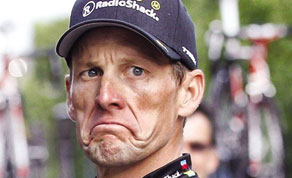
Reuters/Paris
As news broke that Lance Armstrong is to be stripped of his Tour de France titles for doping, there was more than a whiff of Schadenfreude in the home of the epic race the Texan dominated for nearly a decade.

French cycling veterans lamented the stain on the world’s most famous bike race, but the newspapers felt justice was finally being done and online commentators asked whether France might now see more of its cyclists on the podium.
“Armstrong personified impunity. He was seen as too well protected to fall. So the big message today is that impunity is over,” said Damien Ressiot, a sports reporter who published the first doping allegations against Armstrong in the sporting daily L’Equipe seven years ago to the day.
“What is a shame is that by saying he accepts the decision, Armstrong will avoid a public debate so we’ll never know exactly what happened and how he was able to cheat for so long.”
Beating testicular cancer to win the Tour an unprecedented seven times, Armstrong, clad in the leader’s yellow jersey, came close to personifying the race from 1999 until his retirement last year, popularising it with millions of Americans.
He also became an inspiration for cancer sufferers worldwide.
On Thursday, Armstrong dropped his fight against doping charges, and the US Anti-Doping Agency said he would be stripped of his titles and banned from competitive cycling.
While the American, who speaks basic French, was always publicly cheered in the country that made him one of cycling’s greats, many people regarded him as standing for a generation of cheats who always seemed to get away with it.
“The rotten years of cycling have been identified and Lance Armstrong is out,” Jean-Rene Bernaudeau, head of French cycle racing team Europcar, told Reuters.
“We are working as hard as we did then and we have better results. French cycling has regained its standing.”
Veteran French racing cyclist Laurent Jalabert, widely popular in France though he never won the Tour, told RTL radio he felt sadness and anger at the blight on both the Tour de France and the wider world of professional cycling.
“The axe has fallen,” wrote daily newspaper Le Figaro in its online edition. “Some people will be furious but others will see justice being done.”
Le Monde said Armstrong’s downfall should serve as a turning point for the sport. “Saint Armstrong, pierced with arrows, has finally succumbed,” the newspaper said in an editorial. “This illustrates anew that this sport is poisoned by doping.”
Many in France are angry at the way doping has come to overshadow the glory of a punishing three-week race that courses 3,500 km (2,200 miles) through the mountains and valleys of France at breakneck speed and has been held every year, except in wartime, since 1903.
While French cyclists have over the years been most successful in the event, winning 36 of the 94 tours, the last Frenchman to win was Bernard Hinault back in 1985.
Since then, American and Spanish riders have dominated, with Armstrong and Spaniard Miguel Indurain recording seven and five wins each. This year’s Tour was won for the first time by a Briton, Olympic gold-medallist Bradley Wiggins.
“That’s it—we are going to have a Frenchman back on the podium,” one online reader of L’Equipe commented in reaction to the Armstrong story.
“At last!” said another. “Everyone knew (Armstrong) was guilty—he was the only one able to talk without panting when he got to the top of a hill.”
The US Anti-Doping Agency has based its case on eyewitness accounts that Armstrong, along with other leading Tour de France cyclists, were injecting themselves with the blood booster EPO, testosterone and other performance-enhancing drugs.
While Armstrong is only one among several Tour de France champions accused of doping, he is by far the most prominent.
Bernard Thevenet, who won the Tour de France twice, said stripping Armstrong of the titles that have made his fortune and turned him into a global brand would send a clear message that things have changed.
“If Armstrong cheated then it’s perfectly reasonable that he should be punished,” he told RTL radio.
“It’s a very strong message for cyclists and those around them who might be tempted to cheat.”
Ressiot, for whom Armstrong’s fall feels like vindication for his years-long quest to get recognition for his claims that urine samples from Armstrong in 1999 had tested positive for EPO, said the best outcome would be to set up a much more stringent testing system.
“Of course this hurts the Tour’s image, but the stain from doping affairs of the last 15 years was already catastrophic so I don’t think anyone is surprised. The problem today is that all great sporting results are viewed with suspicion,” Ressiot said.
“I am saddest for the cancer sufferers who made Armstrong a hero. He biggest crime was to lie to those people,” he said.
FACTBOX
Lance Armstrong profile: Born: Sept. 18 1971, in Texas, US
EARLY CAREER
• Finishes 14th in the individual road race at the 1992
Barcelona Olympics. Turns professional.
• In 1993 he wins a Tour de France stage at Verdum. Wins the
Triple Crown in the US and world championship in Oslo, Norway.
• Twelfth in road race and sixth in individual time trial at
1996 Atlanta Olympics.
• Signs for the Cofidis team but is diagnosed with testicular cancer and given less than a 50% chance of survival. Has surgery and aggressive chemotherapy.
• In 1997 he is declared free of cancer. Joins the US
Postal team.
TOUR DE FRANCE
• Wins the Tour de France for the first time in 1999, taking four stage victories on the way.
• Earns a second Tour victory and wins a bronze medal for the individual time trial at the 2000 Sydney Olympics.
• In 2001 he becomes only the fifth man in 88 editions of the Tour to win three or more times in succession following Louison Bobet (1953-55), Jacques Anquetil (1961-64), Eddy Merckx (1969-72) and Miguel Indurain (1991-95).
• Takes his fourth Tour title in 2002 - one short of the record held by Anquetil (France), Merckx (Belgium), Bernard Hinault (France) and Indurain (Spain). Wins four stages and wears the yellow jersey continuously after taking it on stage 11.
• Takes the Tour de France yellow jersey on the eighth stage to L’Alpe d’Huez on his way to a fifth victory in 2003.
• In 2004 he wins a record sixth Tour de France after taking control of the yellow jersey with victory on the 15th stage.
• Retires in 2005 after winning the Tour for an unprecedented seventh consecutive time.
DOPING ALLEGATIONS
• May 31 2006 - Armstrong is cleared of doping by an independent investigation launched by the International Cycling Union (UCI) after French newspaper L’Equipe published allegations that six of his urine samples from the 1999 Tour showed traces of the blood-boosting drug erythropoietin (EPO).
BACK ON THE BIKE
• Sept 9 2008 - Armstrong announces he will come out of retirement to compete in the 2009 Tour de France to raise awareness of the global cancer burden.
• Finishes third in the 2009 Tour de France behind Spain’s
Alberto Contador and Luxembourg’s Andy Schleck. Returns a year later to finish 23rd after a crash in the first mountain stage brought an end to any hopes of a title challenge.
• In his last race, Armstrong finishes 65th overall and almost six minutes adrift of race winner Cameron Meyer of Australia in the 2011 Tour Down Under as continued allegations over illegal doping overshadowed his swansong.
• Announces second retirement from competitive cycling on
Feb 16, 2011.
DOPING ALLEGATIONS RETURN
• June 2012 - USADA officially charges Armstrong with doping, based on blood samples from 2009 and 2010, and testimonies from other cyclists. Armstrong was charged in a letter from USADA, along with five others, including former team manager Johan Bruyneel.
• On July 9, Armstrong files lawsuit against the USADA, which a federal court judge threw out later the same day. The following day he files a revised lawsuit, once again asking to stop the agency from stripping his seven Tour de France titles and banning him from the sport for life if he failed to submit to arbitration over alleged doping violations.
• Armstrong’s lawsuit claimed that the USADA did not have jurisdiction and that his right to due process was being violated but it was thrown out by US District Judge Sam Sparks on Aug 20, who upheld the USADA’s jurisdiction in the case.
• Aug 23 - Armstrong says he is ending his fight against the
USADA, but maintains they lack jurisdiction to strip him of his Tour de France titles.
Legendary cyclist Lance Armstrong lost his seven Tour de France titles, 2000 Olympic bronze medal and other awards including the prize money he has won since 1998 after he decided not to contest the US Anti-Doping Agency’s charge that he used performance-enhancing drugs
The following is the emotional statement issued Thursday night by Armstrong:
There comes a point in every man’s life when he has to say, “Enough is enough.” For me, that time is now. I have been dealing with claims that I cheated and had an unfair advantage in winning my seven Tours since 1999. Over the past three years, I have been subjected to a two-year federal criminal investigation followed by Travis Tygart’s unconstitutional witch hunt. The toll this has taken on my family and my work for our foundation and on me leads me to where I am today - finished with this nonsense.
I had hoped that a federal court would stop USADA’s charade. Although the court was sympathetic to my concerns and recognised the many improprieties and deficiencies in USADA’s motives, its conduct, and its process, the court ultimately decided that it could not intervene.
If I thought for one moment that by participating in USADA’s process, I could confront these allegations in a fair setting and - once and for all - put these charges to rest, I would jump at the chance. But I refuse to participate in a process that is so one-sided and unfair. Regardless of what Travis Tygart says, there is zero physical evidence to support his outlandish and heinous claims. The only physical evidence here is the hundreds of controls I have passed with flying colours. I made myself available around the clock and around the world. In-competition, out of competition, blood. Urine, whatever they asked for I provided. What is the point of all this testing if, in the end, USADA will not stand by it?
From the beginning, however, this investigation has not been about learning the truth or cleaning up cycling, but about punishing me at all costs. I am a retired cyclist, yet USADA has lodged charges over 17 years old despite its own 8-year limitation.
As respected organisations such as UCI and USA Cycling have made clear, USADA lacks jurisdiction even to bring these charges. The international bodies governing cycling have ordered USADA to stop, have given notice that no one should participate in USADA’s improper proceedings, and have made it clear the pronouncements by USADA that it has banned people for life or stripped them of their accomplishments are made without authority. And as many others, including USADA’s own arbitrators, have found, there is nothing even remotely fair about its process.
USADA has broken the law, turned its back on its own rules, and stiff-armed those who have tried to persuade USADA to honour its obligations. At every turn, USADA has played the role of a bully, threatening everyone in its way and challenging the good faith of anyone who questions its motives or its methods, all at US taxpayers’ expense. For the last two months, USADA has endlessly repeated the mantra that there should be a single set of rules, applicable to all, but they have arrogantly refused to practice what they preach. On top of all that, USADA has allegedly made deals with other riders that circumvent their own rules as long as they said I cheated. Many of those riders continue to race today.
The bottom line is I played by the rules that were put in place by the UCI, WADA and USADA when I raced. The idea that athletes can be convicted today without positive A and B samples, under the same rules and procedures that apply to athletes with positive tests, perverts the system and creates a process where any begrudged ex-teammate can open a USADA case out of spite or for personal gain or a cheating cyclist can cut a sweetheart deal for themselves. It’s an unfair approach, applied selectively, in opposition to all the rules. It’s just not right.
USADA cannot assert control of a professional international sport and attempt to strip my seven Tour de France titles. I know who won those seven Tours, my teammates know who won those seven Tours, and everyone I competed against knows who won those seven Tours. We all raced together. For three weeks over the same roads, the same mountains, and against all the weather and elements that we had to confront. There were no shortcuts, there was no special treatment. The same courses, the same rules. The toughest event in the world where the strongest man wins. Nobody can ever change that. Especially not Travis Tygart.
Today I turn the page. I will no longer address this issue, regardless of the circumstances. I will commit myself to the work I began before ever winning a single Tour de France title: serving people and families affected by cancer, especially those in underserved communities. This October, my Foundation will celebrate 15 years of service to cancer survivors and the milestone of raising nearly $500 million. We have a lot of work to do and I’m looking forward to an end to this pointless distraction. I have a responsibility to all those who have stepped forward to devote their time and energy to the cancer cause. I will not stop fighting for that mission. Going forward, I am going to devote myself to raising my five beautiful (and energetic) kids, fighting cancer, and attempting to be the fittest 40-year old on the planet.
WADA chief wanted Armstrong to face tribunal
Paris: WADA chief John Fahey yesterday said Lance Armstrong’s decision not to fight drug charges would be seen as an admission of guilt and he was disappointed the American would not face a tribunal.
“I would have liked to see the accusations, the innuendo, the rumours that have been going round for years tested in an open tribunal and a proper process, whatever the outcome was, so the whole world would have known what the facts were,” he told ABC radio.
Armstrong maintains his innocence and accused USADA of launching an “unconstitutional witch hunt” against him as he declined to pursue procedures that could take his case to the Court of Arbitration for Sport.
But the World Anti-Doping Agency boss, an Australian, said the seven Tour de France winner’s decision not to challenge the charges could only been as an admission of guilt.
“There can be no other interpretation,” he said. “His failure to rebut the charges allowed the USADA to take that as an admission of guilt and to impose sanctions.
“I believe USADA acted properly. They laid very serious charges, he has chosen not to rebut those charges,” he added.
“He can say what he likes. The only way we would have known what the substance was of those charges, what the evidence was, was to have the evidence tested and I’m disappointed that won’t occur.” The US Anti-Doping Agency said the American rider will be stripped of his Tour de France titles. Armstrong’s decision came after a US federal court dismissed his lawsuit against USADA on Monday, paving the way for the agency to continue its case against him.
USADA claims Armstrong used banned substances, including the blood-booster EPO and steroids, as well as blood transfusions dating back to 1996. It also says it has 10 former Armstrong teammates who were ready to testify against him. The 40-year-old, who retired from cycling last year, argued that USADA was usurping the jurisdiction that should belong to world cycling’s governing body, the International Cycling Union. But Fahey said this did not wash.
“He’s competed in a sport which has subjected itself willingly to the world anti-doping code,” he said. “He’s abided by those rules competing and I think it’s a bit cute now to say that that process doesn’t work. “WADA is satisfied that USADA acted within the rules that are in compliance with WADA’s code.”He added that Armstrong’s failure to pursue his challenge against the charges sent a message that drug cheats would be pursued rigorously. “It does say that there is a process out there that now applies in 193 countries in the world, where those that want sport to be clean and to protect clean athletes, will do what they can to catch cheats.”