AFP/Kiev
Street violence and alleged racism in the stands at Euro 2012 have thrown the spotlight squarely on the interplay between football hooliganism, the far right and organised crime in Eastern Europe.

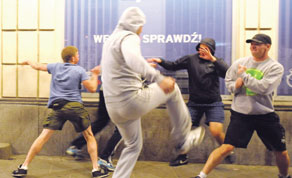
Soccer fans fighting in Warsaw on June 12 after the Group A preliminary round match between Poland and Russia
Even before the start of the first-ever edition of the European championship behind the former Iron Curtain, there were warnings of hooliganism, notably during matches such as Tuesday’s fixture between co-hosts Poland and historical rivals Russia.
More than 180 people, mostly Poles, were detained during street brawls in Warsaw, as police used water cannon, tear gas and rubber bullets to bringing marauding fans under control.
Inside the stadiums, meanwhile, Croatian and Russian fans have lit flares, and the latter also beat up stewards, while UEFA is investigating claims that black players have been taunted.
Since the communist bloc crumbled two decades ago, the region’s stadiums have proved fertile ground for those who lionise England’s once-notorious hooligan “firms” or gangs—but have taken things to a whole new level.
“An individual can at the same time be in a far-right group, a hooligan group and a drug-dealer group,” Serbian security analyst Zoran Dragisic told AFP.
In Poland, police estimates put the hardcore hooligan element at up to 5,000.
While that is a minority of the tens of thousands who attend league matches—and a drop in the ocean in a nation of 38.2 million—they still have the potential to sow mayhem.
In reality, Polish hooligans tend to gravitate around clubs, not the national team, explaining why fears of Polish hooligans at the 2006 World Cup in Germany or Euro 2008 in Austria fizzled out.
There was, however, trouble at a 2011 friendly away to Lithuania.
“Real club hooligans aren’t interested in Euro 2012,” said Warsaw expert Janusz Czapinski.
“If they had gone into action in Warsaw, the 6,000 police officers deployed in the capital wouldn’t have been enough and the situation would have been far more serious.” The gangs ally with counterparts in other cities and various league levels to draft muscle for “ustawki”—pre-arranged brawls with rivals which have claimed lives in the past.
Long accused of doing too little, and mindful of the Euro 2012 spotlight, Polish authorities cracked down after violence marred the May 2011 Cup Final.
A blanket ban on away fans was imposed for all remaining matches that season, with ad hoc sanctions for clubs in the 2011-2012 season—a broad-brush approach that angered ordinary fans. Poland has beefed up electronic tagging and slapped stadium bans on some 2,000 individuals.
Fellow Euro 2012 host Ukraine adopted a similar approach, with a list of 1,400 individuals considered dangerous, though some fan groups complained of heavy-handed policing in the run up to the tournament. Balkan hooligans, meanwhile, have repeatedly made headlines.
Fourteen Partizan Belgrade fans were recently jailed for the September 2009 murder in the Serbian capital of a fan of French club Toulouse who had come for a Europa League match.
Serbia failed to reach Euro 2012 in part because violence halted their qualifier against Italy.
The nation of 7.2 million is home to several thousand hooligans, according to Dragisic.
“The authorities only take cosmetic steps when there’s an incident,” he said, noting that the crossover to crime syndicates was a growing concern.
“The phenomenon is serious, because hooligans are better and better structured, with an economic bedrock,” said Czapinski.
Last month, Poland detained 42 people on suspicion of being part of a drug trafficking and extortion ring, among them the leader of Legia Warsaw’s “firm”.
In addition, far-right groups have found a ready audience among some fans, though the picture varies.
‘Racist abuse’ against Balotelli at Croatia game
Poznan: Mario Balotelli was racially abused during Italy’s 1-1 Euro 2012 Group C with Croatia at the Municipal Stadium in Poznan, Poland, an AFP photographer at the game said.
The photographer was situated in the corner where the majority of Croatian fans were sitting during Thursday’s match and said he heard monkey noises being directed at Balotelli.
At one point he also saw a steward picking up a banana that had been thrown onto the pitch.
There was no immediate comment from UEFA, who said only that they were awaiting the referee’s report from the match.
On Tuesday UEFA said it was invesigating claims Balotelli, who is of Ghanaian origin, was racially abused during Italy’s 1-1 draw with Spain in Gdansk on Sunday as well as a similar incident in the Russia-Czech Republic match in Wroclaw last Friday when Czech full-back Theodor Gebre Salassie was also allegedly targetted.
Italy coach Cesare Prandelli, though, had strongly rejected the claims that Balotelli was abused against Spain.