


 |
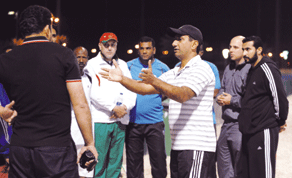
| Tahir Zaman interacts with hockey coaches in Doha |
“We have to accept that we have to improve our coaching abilities. You can get plenty of inputs but you have to put them into practice. We have to learn from the expertise from around the world. Whatever is suitable and adaptable to improve the game, we must use it,” Zaman told the Gulf Times.
“We cannot rest on our past laurels of being champions at the game. That’s the wrong attitude and will take us nowhere. We have to open our eyes and face the fact that we are lagging behind and have to upgrade our coaching tactics. So educating our coach is of utmost importance,” feels Zaman, who is currently in Doha to hone the skills of 18-odd coaches from the region through a FIH approved programme. Zaman, who was the part of the bronze medal winning team at the 1992 Barcelona Olympics, however, feels that teams need not completely abandon the Asian style of play.
“Modern day hockey has evolved. However, I personally believe that our Asian teams, especially India and Pakistan, need to hold on to our strengths and not follow the European strategy completely. We should evaluate and adapt other areas where the Europeans have been effective,” says Zaman, adding that, the European skills come from the indoor hockey they play and the constant work their coaches put in before a match.
“If you look into European teams, their defending structures are much organised. Their skills, mainly from indoor hockey, are very effective and so we should adapt them.
“Everyone is very well aware of the Asian style of play. Our individual ball controlling abilities and skills are phenomenal. But in the modern style of hockey, we cannot receive the ball every time and start running towards the circle. We need to modify our running lines to deceive the opposition. We need to educate where, when and which kind of skill out players need to use.” Zaman also disputed the view that the lack of Asian representation at the Federation of International Hockey has hurt Asian hockey.
“I don’t think that’s the main reason. Yes, maybe a little bit but we have to be blamed for that as our people don’t want to embrace the technical aspects of the game.
“We don’t promote our people to come on to the technical side like the tournament director, official or even the umpiring side. We have to educate people so we can bring them to the FIH and this will give us a voice in decision making areas.” The removal of the off-side rule has also been a topic of debate and has hurt Asian teams the most, feel many. However, Zaman contradicts this view.
“I don’t believe that the removal of off-side rule has anything to do with our teams failing to deliver. Isolating this off-side rule allows players to use more length of the ground.
“If you have more space you can show your skills. It is a challenge for the coaches to make the best use of the rule. The European coaches work more than our coaches and they find out solutions to use those areas to their advantage. We keep on saying, it is not good, rather than finding solution on how to make it more effective,” asserted Zaman, who also runs an academy in Pakistan.Zaman also felt that the need of the hour was to strengthen the domestic structure and make it extremely competitive.
“Our domestic structure is not well organised. Throughout the year we play pressure-less hockey which is very open and allows players to show their individual skills. When it comes to the international hockey which is full pressure hockey, we are all at sea and forget how to play.”