


 |
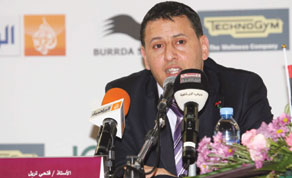
| KEEN TO MOVE FORWARD: Fathi Karbel |
Battling all odds, Libya, newly liberated from the clutches of dictator Muammar Gaddafi, have somehow managed to send in a strong delegation for the Arab Games.
But for them, more than anything, this biggest sporting extravaganza of the Middle East is a platform for redemption, to rejoice, and express their freedom - with an eye towards a better future.
As the interim Minister of Sports & Youth of Libya Fathi Karbel briefed the media on how his country planned to get back on its feet after the recent turmoil, the news of a Libyan bodybuilder Hussen Abdulla winning a silver medal in the 80kg category was conveyed to the media. This was an indication to the Libyans that there is a lot to look forward to as they build a new nation.
“Yes, we somehow managed to make it to the Arab Games battling all odds and I will not hide the fact that all the financial support was given by Qatar. Without that, we wouldn’t have made it to the Games for sure. We are on a recovery path and sports have always been a medium to spread the message of peace and solidarity,” said Karbel, who took charge just 10 days back.
The immediate goal of the interim committee is to get inputs from various sports organisations and try to get their National Olympic Committee back on track.
“Libyan Olympic Committee was headed by Gaddafi’s son and so it was just one man who was taking all the decisions. We would like to get as much information as possible from various countries like Qatar on how their Olympic committees are functioning and on their development programmes.
“I was also in Turkey and Italy as we have sports development contracts with them from the previous regime. We are in consultation with them and hopefully try to get their expertise and look how to get that forward,” added Karbel, who will continue to head the department until an election is held for the post.
Karbel also revealed that restructuring of various clubs are also on the priority list. “We are working on the restructuring of several sports clubs in Tripoli and Benghazi. They were always under tremendous pressure during the earlier regime. We have been liberated but now have to work towards developing a modern world and lay the foundation for civil life and sports is a part of it,” added Karbel.
During the war against Gaddafi, many of the Libyan youth had to take up arms and the biggest challenge for the government is to disarm them and reinstate back into the civil society. And Karbel was of the view that sports, too, can play some role in doing so.
“These are challenges of the Interior Ministry but I would like to say that we would definitely provide opportunities to the youth through sports.
“Sports definitely can be used as a tool to get them back to the civil society,” said Karbel.