


 |
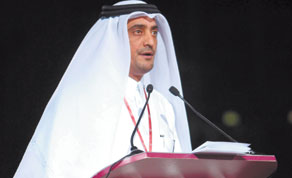
| CONFIDENT: Al-Jabir |
Spearheading the Sports Directorate, Al-Jabir provides an insight into his area of work and his interaction with a worldwide network of sporting bodies.
With Arab Games Doha 2011 just over a few days away, what is it currently like in the Sports Directorate?
We are ready to hit the ground running – we’re just waiting for games time. With the quality of athletes, intensity of competition, and world-class sporting venues, facilities, and training, we are setting the bar very high this time around. Our department is pretty much tying loose ends, and is looking forward to the results of long months of preparation.
What are the main responsibilities of your department?
We are constantly in touch with the athletes. Myself and my team are constantly in touch with national sporting federations – both within Qatar and in the participating countries. The Sports Directorate is in charge of all athlete affairs, in terms of the different competitions to be held, as well as training. The federations are our links to the athletes. We also overview and directly manage all the fields of play in the venues, as well as all training facilities, in addition to the gym and other sporting facilities present in the Athletes’ Village. In addition, we are also in charge of all the referees and technical officials, who will be alongside the athletes on a daily basis during the Arab Games.
Tell us more about your role during games time?
Our role will automatically expand during games time, and will include several additional tasks. The most important task is to manage all the competitions simultaneously. We will be required to ensure that all matters relevant to competition and training (medical, anti doping, transport, catering, and accommodation) are all provided during competition, as well as prior and post each competition. We will have direct control at all venues, and this will be coordinated centrally by the Main Operations Centre.
How did you decide which sports will be included in Arab Games Doha 2011?
The decisions were based on the regulations of the UANOC, which is the governing body of the Arab Games, in coordination with the Arab Sports Federations and AGOC. The previous multisport event hosted by Qatar, the 2006 Asian Games, was also used to assess which sports work well here with the audience, culture, and environment – and we’ve got 29 very exciting sports, so there is definitely something for everyone.
What will the security measures for the athletes be like during the games?
The overall security in Qatar is generally managed very well. Certain specific security measures will of course be taken during the games. They won’t be very obvious on the streets of Doha, but like in any large-scale event where top national figures from so many countries are guests in the host nation, they will be there. The security plan that has been put in hand is very efficient, and has already been tried and tested.
What kind of environment do you hope to create for the athletes in Doha?
As always, we in Qatar, as part of our culture and hospitality, always hope to provide guests and residents with a warm and friendly environment. Particularly now, when we are to host our Arab brothers, with whom we share very close cultural ties, we are really keen on making their experience in Qatar memorable.
What’s your take on the Arab sports scene?
There are many famous athletes participating to the Arab Games and from across the Arab world. Over the last few years, the Arab sports scene has been undergoing a great development, both in terms of athletes and the availability of sports and sporting facilities to the public. Arab athletes are much younger than they used to be in the past, and are nowadays competing in various sports, and on an international elite level.
In Qatar too, more and more young people are developing an interest in not just sports as a hobby, but as a profession and are aspiring to be competitive athletes. More female athletes are emerging across the Arab world, in almost every country. From international youth championships to the Olympics, there are a lot more Arab athletes than ever before. So the horizons for Arab sports and athletes have broadened over the years.
Is there anything special or different about these Arab Games compared to previous Arab Games?
These Arab Games are the first in history designed to be of world-class standards. From the competition venues to the Athletes’ Village, everything will be par excellence. In addition to that, these are the first Arab Games, where some of the sports, such as swimming, have been declared qualifiers for the London 2012 Olympic Games. We hope that the legacy formed by Arab Games Doha 2011 will go on to reflect in future Arab Games events.
How close are the Arab Games standards in Doha going to be in comparison to other major sporting championships such as the Olympics or IAAF World Championships?
Going back to what I mentioned earlier, Arab Games Doha 2011 will set the benchmark for future Arab Games. This event is guided by Olympic standards – there is no room for any compromise on that. For the last decade, Qatar has been organising some great sporting events on a yearly basis, and we believe that the least we can do for all our Arab brothers and friends, is to organise an Arab Games – an event they so eagerly look forward to – of the best possible standards.