


 |
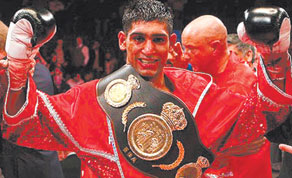
| CONFIDENT: Khan |
World welterweight champion Amir Khan talked of the stress of boxing and his friendship with Gary Speed ahead of his fight against Lamont Peterson in Washington DC next Saturday.
Sport can deflate as surely as it can elevate. In the community of elite athletes, few know more than boxers about the rollercoaster ride that can transport them from the heights of success to the pits of humiliation.
To his great relief, Amir Khan has come through his testing time. Since he was knocked out inside a minute by Breidis Prescott in Manchester in 2008 a fight widely regarded as a full stop in his career, rather than a comma the Bolton boxer has recovered spectacularly to hold versions of the world light-welterweight title, which he will offer up for a fighter with an even more traumatic history, Lamont Peterson, in the American’s home town, Washington, DC, on 9 December.
Peterson and his brother, Anthony, lived on the streets of the nation’s capital for two years when Lamont’s age was still in single digits. Their father went to prison when they were young. Abandoned by a mother whose own problems dwarfed her, the brothers cut cocaine for dealers. They hustled. They slept rough. And, somehow, they survived.
Other athletes succumb. Nobody knows what drove the former Welsh international footballer Gary Speed to take his life at 42, but his death was markedly at odds with his sunny disposition in public. Khan knew him well.
“Yes, he used to come to the gym,” Khan says. “He was a big boxing fan. I used to train with Bolton Wanderers and always saw him there. He was older than a lot of the players, a mentor. He used to give them good advice. It was so sad. I thought of him as a friend. This is really upsetting. My condolences go out to his family ... Shocking news.”
So how does he cope with the pressure of living in that sports bubble? “My training keeps me level-headed, keeps my feet on the ground. If everything around me gets too much, my training totally takes that stress away. It keeps you going. I will never stop training. When I’m out of the gym, when I’ve got a long break [between fights], I’ll always go back, build it up a bit, so as not to get stressed out. It does help.”
Without knowing it, perhaps, he describes the life of Frank Bruno, who came through a sectioning for mental illness to get his life back together. The former world heavyweight champion trains nearly every day to ward off the blues. It is his new addiction.
Is depression a factor in elite sport? “It’s more boredom than anything else,” Khan says. “People when they’re in the gym, training, when [it’s finished], you just don’t know what to do with yourself.”
And what does he do when he’s not training? “I spend a lot of time with the family, stuff like that. The good thing is the family are very close. I like to go to the various cousins. Also, I stress out doing my charity work, lot of travelling. I go to Pakistan now and then. I keep myself busy in the boxing gym as well, because I like to fight three times a year.”
What about his downtime? “Wake up in the morning, go to a training session, maybe take a nap for an hour or two, back in the gym in the afternoon. Soon as that finishes, I chill out at home.
“The one day I have off is a Sunday, and I might catch up with my friends and family at home. Nice and simple.”
Life has not been “nice and simple” for Khan since he went to the 2004 Olympics as Britain’s lone boxing representative, and, ultimately, a silver medallist.
While Khan returned from Athens to a media tumult in the UK, Peterson a Golden Gloves amateur star before he turned pro shivered in doorways. As is the American fairytale, he found a gym and a father figure, Barry Hunter. Peterson now finds himself in a world title fight not far from where he lives.
In the past couple of weeks, Khan has returned to his British TV paymasters, Sky, not to mention the conditioner who turned him into a 10-stone bull, Alex Ariza. They split briefly, before the Paul McCloskey fight in Manchester in April. It was a contractual interregnum, it seems, and a mistake.