


 |
|
|
Senegal’s Lamine Diack was overwhelmingly re-elected president of the International Association of Athletics Federations (IAAF) yesterday, but vice president Sergei Bubka needed a controversial second vote to retain his position.
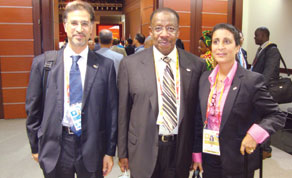
Qatar’s Dahlan Jumman al-Hamad retained his Vice-President’s post in the International Association of Athletics Federations (IAAF) Council with more votes than Sebastian Coe of the Great Britain, signalling his victory may boost the Gulf nation’s chances in the bidding for the 2017 World Championships.
Bubka, the retired world pole vault record holder from Ukraine, had finished an out-of-the running fifth in the original vote by the governing body’s congress.
But officials said there had been a technical problem with the voting system and ordered a new vote by hand.
“We looked at each other and said ‘What is going on,’” said American Robert Hersh, who was re-elected a vice president along with 2012 London Olympics leader Sebastian Coe, Qatar’s Dahlan al-Hamad with Canadian Abby Hoffman, the first-vote co-leader with al-Hamad, fifth.
“I looked at that and instinctively thought that just looks .... it looks a bit of a rogue result,” Coe said of the first vote.
Dahlan, who polled 171 votes in the second and 175 in the first, termed his victory as the triumph of the Emir His Highness Sheikh Hamad bin Khalifa al Thani and the Heir Apparent HH Sheikh Tamim bin Hamad al-Thani and their vision to boost Qatar through sports.
“This is not just my victory. I want to congratulate the Emir HH Sheikh Hamad bin Khalifa al-Thani and the Heir Apparent HH Sheikh Tamim bin Hamad al-Thani for their inspirational role in brining Qatar on the international map through sports. This is also a triumph of the Qatari people. Whatever is Qatar doing in the field of sports is being appreciated by the rest of world. I would like to emphasise that Qatar has played a big role in introducing athletics to the Gulf region and has been popularising it for a long time. I feel that all these factors helped me become the vice-president again,” commented a beaming Dahlan.
“I would like to thank all my friends who supported me in the election,” added Dahlan, who will serve this third term in the IAAF Council.
Bubka, the International Olympic Committee (IOC) member who is tipped along with Coe as leading candidates to succeed Diack in 2015, picked up 41 votes from the first ballot to the second, whose results came more than seven hours later.
The delegates also voted a second time for the unopposed Diack, but there was no controversy. He received 173 yes votes of the 200 ballots cast in the first voting. The count was 169 yes and 29 no the second time around. The four-year term will be the final one for the 78-year-old after serving as the federation’s top official since November 1999. But whether he remains for the full term is open to speculation. Some believe he might become a candidate for the president of Senegal. “There is no way I can be the president there and the president here,” Diack said of the decision he is still to make.
The former Dakar mayor came to power at the IAAF after the death of iron-fisted leader Primo Nebiolo. He has seen the global decline of spectator interest in the sport because of issues like doping and the rise again through the performances of Jamaican world record holder Usain Bolt.
“We are told athletics is a failing discipline ... but I do not believe so,” Diack said in opening remarks to the congress before his re-election. Diack admitted there would be challenges and to assist him, the IAAF announced on Tuesday French administrator Essar Gabriel would join the organization as its new general secretary.