


 |
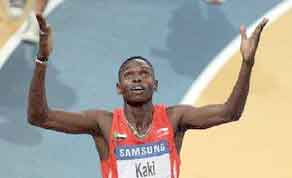
| World indoor 800m champion Abubaker Kaki of Sudan |
The truth is not hidden. All time and annual performances not only prove that athletes can achieve top marks in hot weather, but they can even reach their respective peak in – as the myth says – “difficult” conditions.
Last year’s 5000m race in Doha with Eliud Kipchoge and Vincent Kiprop Chepkok setting the TOP-2 performances in the world (No 32 and No 35 of all time respectively) was not the exception but the confirmation of the rule.
If we could turn the clock back in 2007 we would have seen Kenenisa Bekele running the 5th best race of hic career in the 5000m and 17th in the all-time list, in Zaragoza under 34ºC, with a time of 12:49.53. In the summer of 2008 Sileshi Sihine broke the 13 minutes barrier with a time of 12:58.41 in the Spanish city of Huelva with the mercury in the thermometer reaching the 35ºC line.
If more 5000m races had been included in the past grand prix’s in Doha, the number of the samples would had been increased, like in the 3000m.
In the 3000m athletes have run under 7’30’’ in Qatar’s capital five times and 10 out of the 100 best all time performances have been recorded in races being held in Doha. The best is registered by Eliud Kipchoge, the winner of the 2009 Doha Grand Prix. The Kenyan stopped the clock in 7:28.37 the 24th best time ever, which is less than 60/100 of a second slowest than his personal best. Temperature in Doha that day was 39ºC.
Another Kenyan, Ausustine Kiprono Choge set in 2005 his personal best in 3000m, with a time of 7:28.78, under almost 39ºC in Doha and finished second just behind Kipchoge’s (7:28.56). This is the 33rd mark of all time and puts Choge in the 19th spot of the all-time rank.
Other Kenyans like Benjamin Limo and Isaac Kiprono Songok also ran inside 7:30.0, the former 7:28.98 in 2005 and the latter 7:29.98 in 2006 both in Doha with temperatures barely under 39ºC.
Kenyan Thomas Pkemei Longosiwa moved to No 30 spot in the all-time list (59th performance) when he ran a personal best, 7:30.98 in Doha in 2009, and local Gamal Belal Salem broke the Qatari record at the 2005 race in his home town with a time of 7:30.76.
In a year by year analysis, races in Doha produced six TOP-20 performances in 2009, with Eliud Kipchoge’s 7:28.38 being the best of the season. In 2008, six more TOP-20 marks were added in the annual list by Doha’s race and another five in 2007. 2006 Doha Grand prix recorded three of the TOP-5 performances of the season and in 2005, Kipchoge’s 7:28.56 topped the world ranks. In total 5 out of the 20 best marks in that year, were achieved in Doha.
All the above results took place in Qatar with temperatures higher than 35ºC.
The 3000m SC is also included in the “hot” list. Ezekiel Kemboi won the 2009 race in Doha with a time of 7:58.85, the 20th fastest of all time and best in the world in 2009. Kemboi was followed by Paul Kipsiele Koech who set the 52nd fastest time ever and 6th in the specific year, with a time of 8:01.72.
The 2010 3000m SC in Doha produced three TOP-20 performances, the 2008 race one and the 2002 edition another four. All athletes ran its respective races under 8:10.
Undoubtedly if more races in countries with high temperatures had been included in the calendar, we would have seen much more top class performances being added to the world lists. Especially in female events where the lack of international meetings in warm countries is the main reason for limited access to the top lists.
As a result, evidence of women’s capability in adjusting to warm conditions without being affected by the heat is hard to be found but they do exist.
For example three TOP-20 performances courtesy of the Doha meeting were included in the 2005 annual list and one, the 3rd best by Elvan Abeylegesse (8:35.83) in 2004’s.
The 2009 Huelva meeting produced the 4th and 5th fastest times made by Spanish girls Natalia Rodriguez (8:35.86) and Marta Dominguez (8:36.53).
As far as the 3000m SC race is concerned, winner on the 2008 meeting in Huelva, Eunice Jepkorir ran the fifth fastest time in the world that year and subsequently 15th fastest ever (9:11.18), with Mekdes Bekele finishing at the same race with the year’s 18th best.